One Sign-In Shouldn’t Mean Every Store Gets Connected


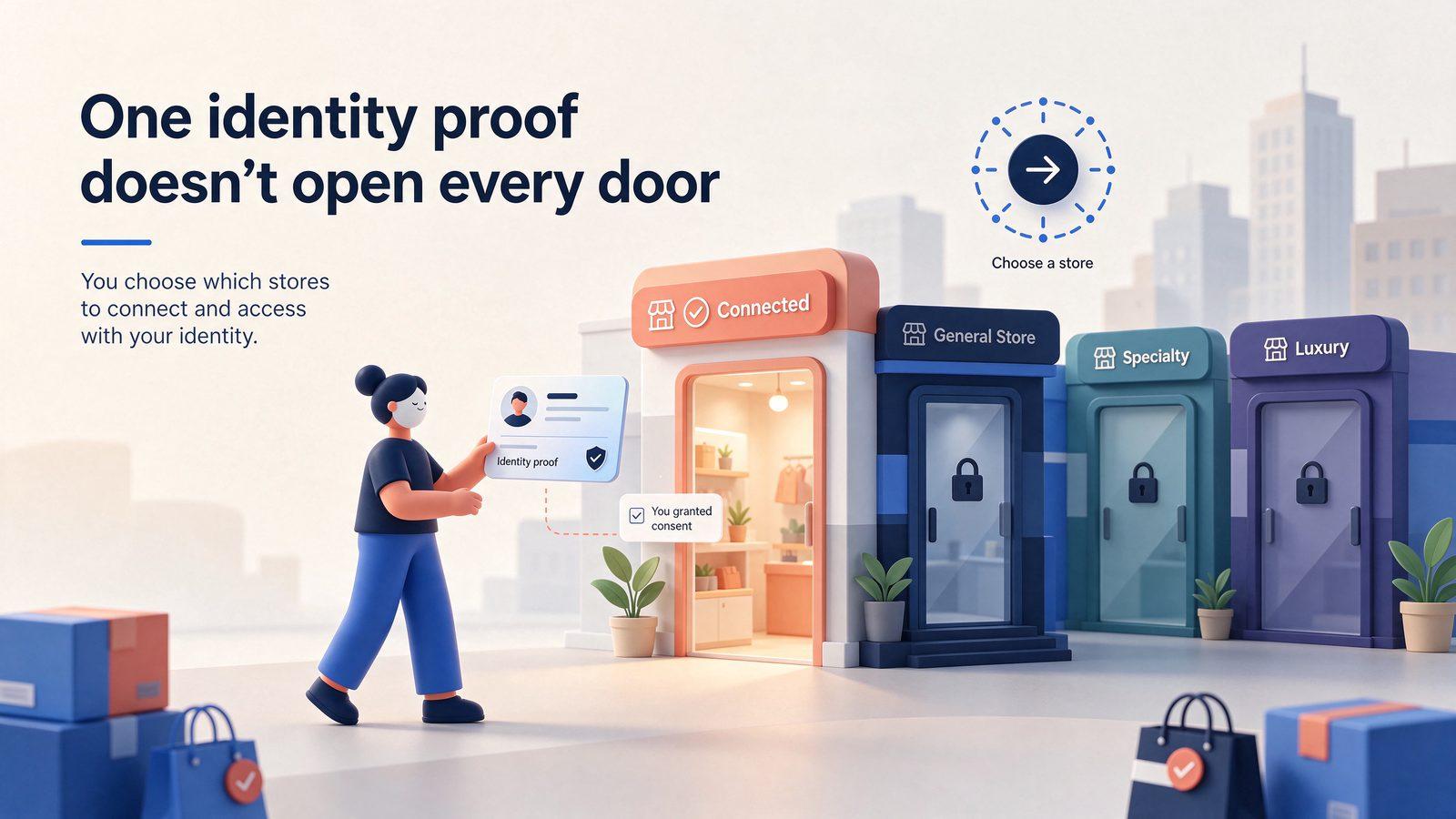
Direct Answer Can an AI shopping assistant skip a loyalty sign-in step because the shopper is already signed in with an email provider? Sometimes, but not because the email addresses match. A store should reduce verification only when a trusted issuer vouches for the address, the store has verified the address on its own customer record, and no other account link conflicts. Even then, the shopper should still choose which store to connect.
A shopper is already signed in with their email provider and asks an AI assistant to check their rewards at your store. Almost immediately, they’re asked to verify the same email address again.
From their side, that feels redundant. From yours, the obvious shortcut is risky: take the email from the assistant’s session, find the matching customer record in your store, and connect the account automatically.
Repeating a check can cost you the moment a shopper was ready to use their rewards. But seeing the same text in an email field doesn’t tell you who vouched for that address, whether your store ever verified it, whether the loyalty account is already tied to someone else, or what the shopper agreed to share.
Tell us where your shoppers have to verify twice, and mention “simpler linking.”
Key takeaways
- A matching email string is a clue, not proof of identity or account ownership.
- Identity, account matching and consent are three separate questions.
- UCP #998 allows email-based initial matching only under four strict conditions.
- A changed email must never silently move a loyalty account to someone else.
- Stabile keeps sign-in and store access separate, and no cross-store linking happens silently.
What does this mean for my store?
If you run a loyalty program, three things matter:
- Your customers’ rewards stay private. A sign-in shortcut should never expose balances or codes to the wrong person.
- Your accounts stay accurate. A sloppy email match can attach one person’s points to someone else’s profile, and that is expensive to untangle.
- Your shoppers stay in control. Connecting to your store should be a choice the shopper makes, not a side effect of signing in somewhere else.
Fewer steps are worth pursuing, but not at the cost of any of these.
What three questions does every loyalty connection need to answer?
When an assistant connects a shopper to a store’s loyalty program, three different questions need answers:
| Question | What it means | Why it stays separate |
|---|---|---|
| Who is the shopper? | A trusted identity system has made a claim about the person. | An identity claim needs trustworthy evidence and a stable identifier. |
| Which store account is theirs? | Your store has resolved the request to one specific loyalty account. | A matching email alone doesn’t settle conflicts or ownership. |
| What may the assistant access? | The shopper has agreed to a specific store connection and scope. | Proving identity doesn’t grant permission to view or use rewards. |
Answering the first question doesn’t answer the other two. Even strong proof of identity still needs safe account matching and the shopper’s explicit consent at each store.
What did UCP #998 change?
Universal Commerce Protocol (UCP) is an emerging protocol effort for communication between commerce systems and AI agents. A recent change, UCP #998, describes a narrow exception for initial account matching by email. It was merged into UCP’s main branch on October 31.
A business may match an account by email at the start only when all four of these hold:
- The business independently trusts the identity issuer as the mailbox authority for that email domain.
- The issuer asserts
email_verified: true. - The business has verified the email address stored on its own customer record.
- No conflicting identity or account link already exists.
That is far narrower than “the email strings match.” A provider saying an email is verified is not universal authority to merge accounts. An email sitting in your customer table isn’t proof that you verified it. And a one-time code sent by an app to a Gmail address doesn’t make that app Gmail’s mailbox authority.
A merge into main is a specification update. It is not a tagged UCP release, a Shopify platform feature, or a live Stabile integration.
Implementer sidebar: ask for the proof, not just the field
Before using an upstream identity claim for account matching, you should be able to describe the issuer, the stable subject identifier, the verified-email signal, your trust relationship with the issuer, and what happens when an account is already linked. Keep identity proof separate from consent: a trustworthy claim helps answer “who is this?” It doesn’t answer “which store account?” or “what may this assistant access?”
What happens if a shopper changes their email?
A changed email must not move an account. Safe linking also depends on what happens after the first connection.
Suppose a shopper links their loyalty account at your store through a verified identity. Months later, they change the email address at their provider, or an old address is reassigned to someone else.
If your store kept matching on whatever email appears in a later request, the shopper could lose access, or a different person’s session could land on the wrong rewards balance.
A safer model ties the connection to the issuer and subject (who vouched, and a stable identifier for the person) rather than the email text. The email can update as an attribute, but changing it should never silently move the loyalty relationship to a different account. When a business accepts a claim, it should keep the evidence that justified the original connection.
How does Stabile handle this today?
Today, Stabile keeps sign-in and store access separate:
- Account sign-in uses email verification.
- Store access depends on the store-link and consent flow. As described in the Stabile Wallet launch overview, saving a reward links that store, and later rewards stay accessible while the connection is enabled.
- No silent cross-store linking. A matching email at another store doesn’t link that store, and personal reward codes aren’t part of public reward-term lookups.
We’re considering whether a trusted upstream identity proof could remove a redundant verification step in some situations. Doing that would require a named integration, clear trust evidence, conflict handling and a consent design. No Google, Microsoft, Shop or other provider has been selected or announced.
Separately, we’re exploring store discovery through a verified Stabile email. That is a different idea from the UCP mailbox-authority exception and shouldn’t be confused with it.
Frequently asked questions
Is a matching email address enough to connect a shopper to a loyalty account? No. A matching email shows two records contain the same text. It doesn’t show who verified the address, whether your store verified it, whether another identity is already linked, or whether the shopper agreed to the connection.
What is a mailbox authority? The party that controls and can vouch for the mailboxes on an email domain. Under UCP #998, a business must independently trust the issuer in that role before using its verified-email claim for initial matching. Sending a one-time code to an address does not make an app the mailbox authority for that domain.
Does UCP #998 mean one-click loyalty sign-in is live?
No. It is a specification change merged into UCP’s main branch. It is not a tagged release, a Shopify feature or a Stabile integration, and it doesn’t promise frictionless sign-in.
What stops a changed or reassigned email from moving a loyalty account? Tying the connection to the issuer and a stable subject identifier instead of the email text. The email can update as an attribute without redirecting the existing link.
Does Stabile link a store automatically if the shopper’s email matches there? No. A matching email at another store doesn’t link that store. Linking follows the store-link and consent flow described in the Wallet launch overview.
Has Stabile chosen an identity provider for this? No. No Google, Microsoft, Shop or other provider has been selected or announced. This is feedback gathering.
Where do your shoppers get stuck? Tell us.
We’d like concrete examples before deciding what to build next.
- If you run a store: Where do your shoppers have to verify themselves again to reach their rewards? Tell us your store, the sign-in system involved and the step you’d most like to remove. Send your example and mention “simpler linking.”
- If you build platforms or agents: Tell us which integration you’re building and what identity proof it can supply, using the same contact page.
Please share high-level descriptions only. Don’t send credentials, tokens, customer records, live codes or private account data. This is feedback gathering, not provider enrollment, and not a promise that accounts will be found automatically.
Make your store’s rewards available in AI-assisted shopping
To try Stabile’s existing loyalty and Wallet features, install Stabile’s Shopify app, then message us in the app about Wallet setup for your store.
Already using Stabile? Message us in the app and we’ll help you get set up. The identity-proof direction discussed here is exploratory; Wallet setup gives shoppers access to the saved-reward features available today.