A Reward Code Is Not Yet a Discount


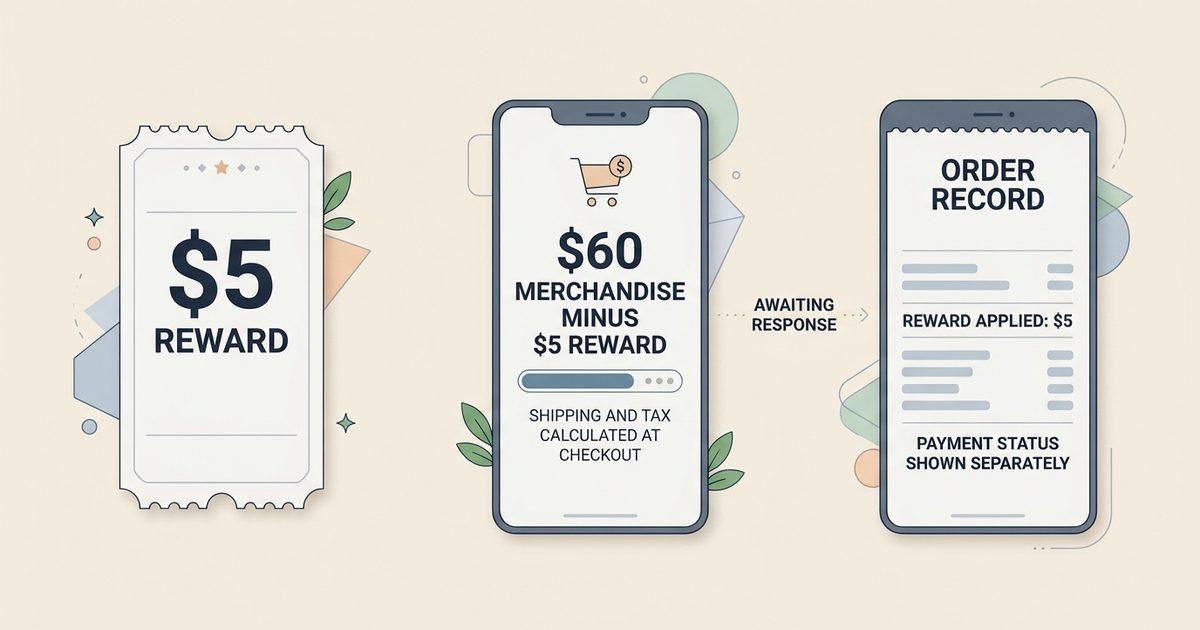
Direct Answer A reward code becomes a checkout discount only when the store accepts it for that cart. An AI assistant’s after-reward estimate does not confirm eligibility, the final amount due or a completed purchase. Merchants need separate evidence of reward availability, discount acceptance and order status. Stabile Rewards Wallet helps shoppers find saved rewards and estimate merchandise prices; the shopper still uses the code and completes checkout at the store. We’re gathering merchant examples to guide further checkout work.
A shopper has a $5 reward from your store. Their merchandise subtotal is $60. An AI assistant shows:
“$55 after reward.”
That may help them compare prices. It can also leave them expecting a $55 checkout total before the store has checked the code or calculated shipping and tax.
Then imagine a checkout integration submits the code, but the response never arrives. Did the store reject it? Accept it? Is it still processing?
For a merchant, those are different support questions. An assistant needs to preserve the distinction as it helps a shopper move from considering an offer to placing an order.
Why isn’t an after-reward estimate the final checkout price?
In this illustrative USD example, $60 minus a $5 reward gives an estimated $55 merchandise price. That calculation assumes the reward applies to the items in the cart.
Checkout still needs to check eligibility, minimum spend, expiry and discount-combination rules. Shipping, tax and other discounts can also affect the amount due.
A clearer assistant response would be:
“Your $5 saved reward could bring this $60 merchandise subtotal to $55 if checkout accepts it. Shipping, tax and other discounts aren’t included. Your store’s checkout will confirm the amount due.”
The shopper can use that estimate without mistaking it for an accepted offer. The merchant keeps control of the rules that determine whether the reward applies.
Our previous article on explaining loyalty rewards examined what an order might earn. This article follows the next question: what confirms that an existing reward was actually used?
What should confirm each stage of reward use?
These checks form a progression, but each needs its own evidence. Passing one does not establish the next.
| Stage | Evidence to look for | What remains unconfirmed |
|---|---|---|
| 1. Reward available | The shopper can access an issued reward and its terms through an authorized account or reward flow. | Whether it applies to this cart. Availability alone also does not authorize an assistant to make a purchase. |
| 2. Discount accepted | The store’s checkout reports the applied reward and updated totals for the current cart. | Whether an order has been placed or payment completed. |
| 3. Order status confirmed | The store’s order record shows the resulting order, recorded discount and current payment status. | Later fulfillment, cancellation or refund outcomes. An order can exist while payment is pending. |
This gives a merchant a practical way to investigate “my reward didn’t work.” Was the reward available? Did checkout accept it? Does the order show the discount? What payment status does the store report?
A useful assistant should be able to say which answer it has—and which it is still waiting for.
What should happen if checkout doesn’t return an answer?
A missing response means the outcome is unknown. It does not establish that the code failed.
In our hypothetical integration, the next step should be to check the existing checkout or operation. If the store reports the reward as applied, the assistant can show the updated totals. If it reports a rejection, the assistant can explain the reason. If no reliable answer is available, it should say that confirmation is still pending.
A retry can be appropriate when the integration supports safely repeating the same request. Starting a fresh reward issuance or purchase is a separate action and needs separate handling. Reapplying a code should not be casually equated with issuing another reward or charging a customer again.
For the shopper, the useful message is simple: “I haven’t confirmed the result yet.” That is more helpful than a confident failure message that sends them through checkout again unnecessarily.
What do recent UCP discussions mean for merchants?
Universal Commerce Protocol (UCP) describes how commerce systems and AI agents communicate. Two recent discussions illustrate why checkout updates, completion and order records deserve separate treatment.
A proposal to supply additional buyer and shipping details at completion was closed on November 7. The closing explanation retained updating checkout before completing it, rather than allowing completion to change pricing. For merchants, the relevant principle is that completion should finalize the checkout the buyer reviewed. That discussion concerned payment-wallet flows, a different function from Stabile’s saved-reward Wallet.
Another proposal, UCP #1089, would add optional applied-discount details to the order record. It remained open when checked on November 16, 2026. Such a record could help identify which discount was used; it would not itself establish payment capture or refund handling.
Our takeaway is to keep the accepted checkout and resulting order traceable. These discussions inform the questions we want to test; they are not an announcement of new Stabile checkout functionality.
What does Stabile Rewards Wallet do today?
Stabile Rewards Wallet in ChatGPT lets shoppers view saved rewards and unused codes from linked stores and compare estimated merchandise prices after saved rewards. Those estimates exclude shipping, tax and other discounts.
The shopper uses the code and completes the purchase at the store’s normal checkout. The Wallet does not automatically apply the code or complete payment.
We have also published a separate controlled demo-store checkout test. Its results describe that test environment, with a human completing payment; they do not extend the published Wallet’s capabilities.
We’re now gathering examples to decide which checkout scenarios deserve further evaluation: rejected rewards, discount combinations, changed totals and missing responses. The aim is to identify specific gaps before choosing what to build.
FAQ
Does seeing a reward in ChatGPT mean checkout will accept it?
No. A saved reward shows an available benefit and its terms. The store’s checkout checks whether the code applies to the current cart.
Does an accepted discount mean the order is paid?
No. Discount acceptance confirms a checkout calculation. The order and payment records establish what happened afterward; payment can still be pending.
Can Stabile Rewards Wallet finish checkout for a shopper?
No. The published Wallet shows saved rewards and estimated merchandise prices. The shopper uses the code and completes checkout at the store.
Where does reward use become unclear in your store?
Have customers asked about a rejected code, a discount combination, a changed total or a checkout result they couldn’t confirm?
Tell us your store and one example, and mention “checkout confidence.” A short description is enough; leave out customer information, live codes and order identifiers. Your examples will help us decide which scenarios to evaluate next.
Make your store’s rewards available in AI-assisted shopping
To try Stabile’s existing loyalty and Wallet features, install Stabile’s Shopify app, then message us in the app about Wallet setup for your store.
Already using Stabile? Message us in the app and we’ll help you get set up. The checkout evaluation discussed here is proposed work; Wallet setup gives shoppers access to the saved-reward features available today.