Team USA, the Knockout Round, and What a Tale of Two Stadiums Says About Commerce Infrastructure

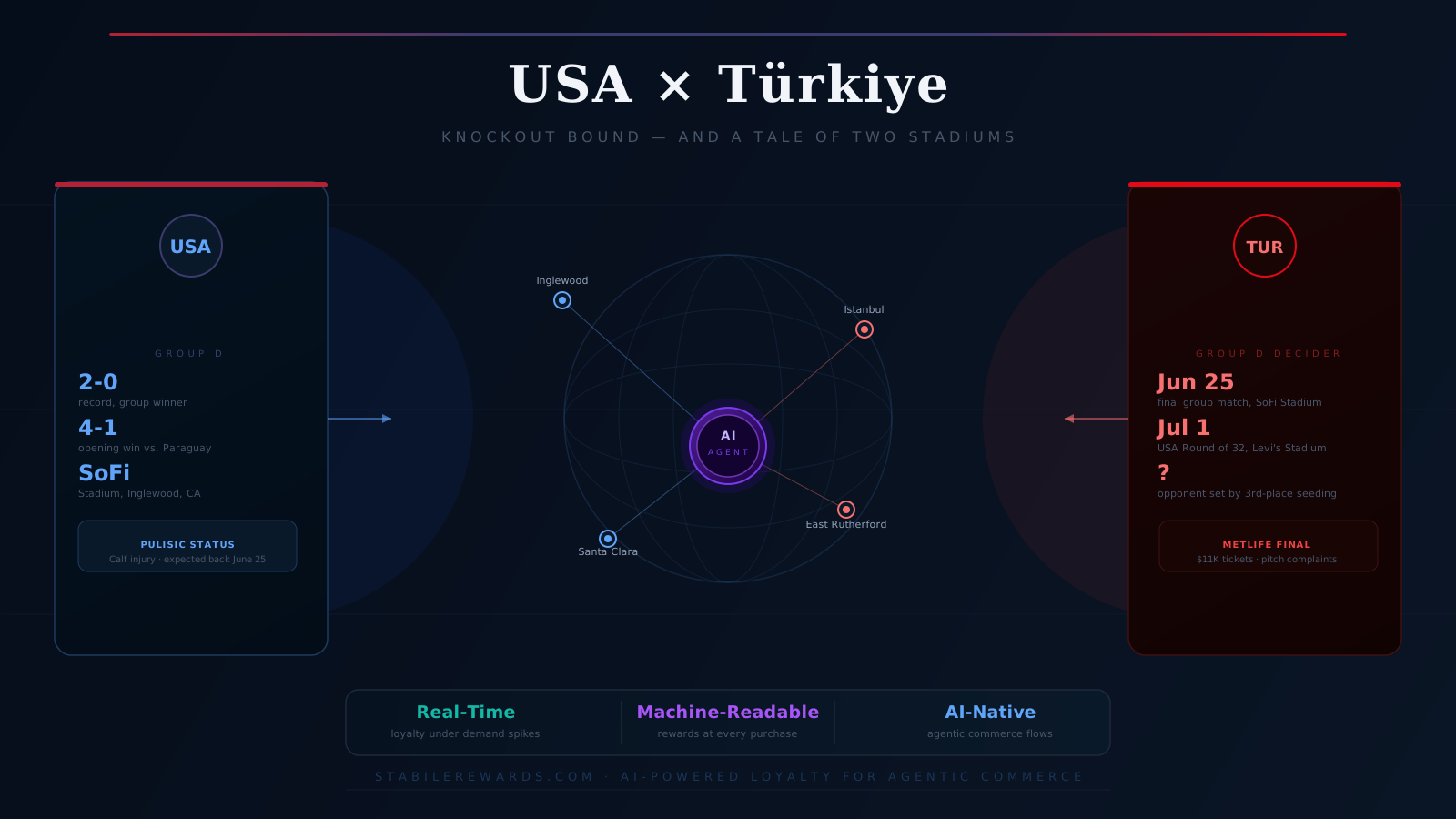
Direct Answer Team USA has already clinched first place in Group D at the 2026 World Cup, winning both group matches at SoFi Stadium without star forward Christian Pulisic, who is expected back for the June 25 finale against Türkiye. Their Round of 32 opponent on July 1 at Levi's Stadium won't be known until the rest of the group stage finishes, because eight third-place teams across all 12 groups also advance. Meanwhile, the tournament's host venues are diverging sharply in reputation: SoFi Stadium has drawn praise all group stage, while MetLife Stadium — set to host the July 19 final — is facing real criticism over $11,000 final tickets and a pitch multiple players have called hard and prone to drying out. That divide is a preview of a much bigger problem: fan demand for tickets, merchandise, and loyalty rewards is moving faster, in real time, than the infrastructure built to serve it — and that gap is exactly what machine-readable, AI-native commerce infrastructure is built to close.
Team USA didn't just win Group D at the 2026 World Cup.
It won it on home soil, twice, at SoFi Stadium — without even needing its biggest name on the field for either match.
A 4-1 rout of Paraguay. A clinical 2-0 win over Australia. Both wins came with Christian Pulisic sidelined by a calf injury picked up in the opener.
That locked up first place in Group D before the group stage was even finished.
And it opened up three different storylines fans are tracking in real time — each one a small preview of the same larger gap in commerce infrastructure.
Three Open Questions, One Underlying Pattern
Will Pulisic start against Türkiye? Reports suggest he's expected to be fit for the June 25 finale at SoFi — but with first place already locked, Pochettino has the flexibility to manage his return carefully, prioritizing the knockout rounds over the dead-rubber-adjacent group finale. Fans don't know which version of the lineup they'll see until kickoff.
Who do they face in the Round of 32? The U.S. knows its knockout date (July 1) and venue (Levi's Stadium, Santa Clara) — but not its opponent. Twelve group winners and twelve runners-up advance automatically, plus the eight best third-place teams across all 12 groups, determined by an elaborate seeding formula. That means the bracket genuinely can't be filled in until the last whistle blows in groups that have nothing to do with the U.S. directly.
Türkiye's own situation adds another layer. With Türkiye likely already eliminated from advancing regardless of the result, the June 25 match carries asymmetric stakes — pride and seeding for Türkiye, lineup management and momentum for the U.S.
Each of these is a live, unresolved variable. And each one is driving the same behavior: fans checking schedules obsessively, searching for ticket and travel options before they're certain they'll need them, and trying to plan purchases around outcomes that haven't happened yet.
That's not a niche fan behavior. It's the default mode of modern sports commerce — and it's a preview of how AI shopping agents will increasingly need to operate too: making provisional decisions, holding options open, and acting the moment new information lands.
A Tale of Two Stadiums
While the knockout bracket sorts itself out, a different story is unfolding around the venues themselves.
SoFi Stadium has been a showcase all group stage — modern, well-reviewed, the site of two dominant U.S. wins in front of an electric home crowd.
MetLife Stadium, set to host the World Cup final on July 19, is facing a different kind of attention. Final tickets have reportedly listed for as much as $11,000, drawing criticism from fans and even players — USMNT midfielder Timothy Weah called the pricing "too expensive." Beyond cost, several international players have raised concerns about the pitch itself: France's Adrien Rabiot described it as "quite hard and quite rigid," and Brazil's Vinicius Júnior said the surface "dries out very quickly" in the heat, slowing the game down and disrupting rhythm.
Two stadiums, two completely different fan and player experiences — in the same tournament, weeks apart.
That contrast matters beyond sports commentary. It's a visible symptom of something every merchant serving a global, real-time audience eventually runs into: infrastructure built for normal demand breaks down under peak, high-scrutiny demand. A pitch that holds up fine in a regular season buckles under back-to-back World Cup matches in summer heat. A ticketing system built for steady sales spikes into four-figure pricing under tournament-final demand. The cracks only show up when everything is happening at once, in public, with millions watching.
Commerce and loyalty infrastructure has the exact same failure mode.
Fan Demand Doesn't Wait for Certainty — Neither Should Commerce Infrastructure
Every one of these storylines — Pulisic's status, the Round of 32 opponent, the stadium divide — is driving real purchasing behavior right now, before any of it is resolved:
- Fans buying USMNT jerseys without knowing if Pulisic starts
- Fans booking travel to Santa Clara before knowing who the U.S. plays
- Fans deciding whether to chase final tickets at MetLife, weighing cost against a venue already drawing complaints
A human shopper navigates this uncertainty by checking news, refreshing schedules, and accepting some risk. An AI shopping agent acting on a fan's behalf needs something more structured: real-time data it can actually read — schedules, pricing, eligibility, loyalty status — not buried in a push notification or a mobile app session a human has to open.
| What fans need in real time | What most commerce systems deliver |
|---|---|
| Loyalty status that updates the moment a team advances | Rewards that sync on a batch schedule, hours or days later |
| An AI agent that can compare ticket and merch options as news breaks | Pricing and inventory locked behind a human-only storefront session |
| Rewards that travel across venues, merchants, and borders | Loyalty trapped inside one team's or one merchant's app |
| Demand spikes absorbed gracefully across host venues | Uneven infrastructure — one venue thrives, another draws complaints |
The World Cup is a uniquely public stress test of this gap, because every failure — a $11,000 ticket, a pitch that can't hold up, a reward a fan can't redeem in time — happens in front of a global audience, in real time, with no way to quietly patch it overnight.
Building for the Moment Demand Actually Happens
At StabileRewards, this is the exact problem we build for — just outside the stadium, inside everyday Shopify storefronts.
Fan demand around a tournament like this isn't a single moment. It's a sequence of moments — a group win, an injury update, a bracket reveal, a final ticket release — each one triggering a fresh wave of purchasing decisions, increasingly made or assisted by AI agents acting on a shopper's behalf.
Infrastructure built for that reality needs to:
- validate loyalty status in real time — not on a batch cycle that lags the news
- stay readable by AI shopping agents, so recommendations and rewards apply automatically as new information lands
- issue rewards that travel with the customer — across merchants, channels, and borders — instead of staying locked inside one storefront
- hold up under spikes, the way a stadium pitch or a ticketing system needs to hold up under tournament-final demand, not just an average Tuesday
The teams, the bracket, and the stadiums will keep generating headlines through July 19. The underlying lesson won't change: merchants whose systems can act the moment demand shifts will capture it. The ones still waiting on a batch job will watch it happen, the same way fans are watching MetLife's pitch complaints pile up before a ball is even kicked there.
Frequently Asked Questions
Has Team USA clinched a spot in the World Cup 2026 knockout rounds? Yes. The USMNT secured first place in Group D after wins over Paraguay (4-1) and Australia (2-0), guaranteeing a Round of 32 berth before their final group match against Türkiye on June 25.
Will Christian Pulisic play against Türkiye? Pulisic has been sidelined by a calf injury sustained in the tournament opener. Reports indicate he is expected to be fit to play against Türkiye on June 25, though with first place already secured, the coaching staff has flexibility in how they manage his return.
Who will Team USA face in the Round of 32? That isn't determined yet. The U.S. will play its Round of 32 match on July 1 at Levi's Stadium in Santa Clara, but the opponent depends on how the rest of the group stage resolves — including which of the eight best third-place teams across all 12 groups advance.
Why is MetLife Stadium facing criticism ahead of the World Cup final? Final tickets have reportedly been priced as high as $11,000, and multiple international players — including France's Adrien Rabiot and Brazil's Vinicius Júnior — have publicly criticized the playing surface as hard, rigid, and prone to drying out and slowing play in the heat.
What does the SoFi-MetLife stadium divide have to do with commerce infrastructure? Both venues are part of the same tournament, but one is holding up under demand and scrutiny while the other isn't. That's the same failure pattern commerce and loyalty systems face: infrastructure that works fine under normal load can break down exactly when demand peaks — which is also exactly when it matters most to merchants and fans alike.
How does StabileRewards help merchants handle real-time demand spikes like a major tournament? StabileRewards keeps loyalty status machine-readable and updated in real time, so AI shopping agents and storefronts can apply rewards the moment a customer qualifies — instead of lagging behind a batch sync. Rewards are issued as stablecoin-backed tokens that travel with the customer across merchants, which matters most precisely when demand is unpredictable and moving fast.
Get started
Your commerce infrastructure shouldn't be the weak link when demand spikes.
StabileRewards helps Shopify merchants make their loyalty programs visible to AI shopping agents in real time — so rewards keep up with demand, whether it's a steady Tuesday or a World Cup knockout round.
Free to install · Pay on results: 1% of reward value redeemed + $0.05 per AI-channel transaction · No charge if no rewards applied. Install from the Shopify App Store →
StabileRewards Blog — AI-Powered, Blockchain-Secured Loyalty for Agentic Commerce.