What the Spirit Airlines Collapse Reveals About Loyalty Program Risk — and What Comes Next


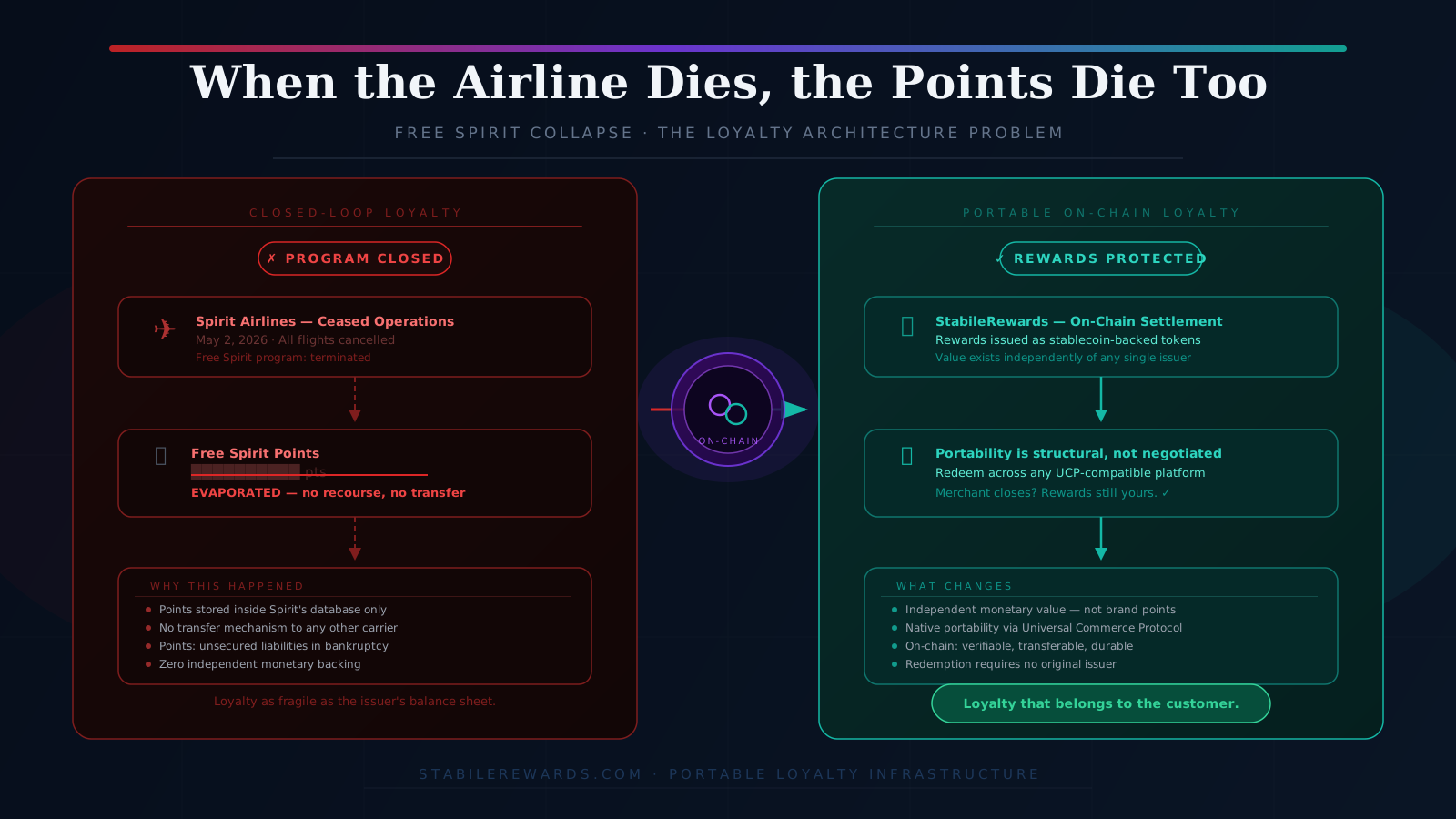
Direct Answer When Spirit Airlines shut down on May 2, 2026, millions of Free Spirit loyalty points became instantly worthless. Members couldn't transfer them. They couldn't redeem them. They couldn't do anything. This is the defining flaw of closed, single-entity loyalty programs: your rewards are only as stable as the company that issued them. Blockchain-anchored, platform-portable loyalty infrastructure — like StabileRewards — is designed to eliminate exactly this risk.
This morning, Spirit Airlines ceased all operations.
Every flight cancelled. Customer service offline. And millions of Free Spirit loyalty points — gone.
Not paused. Not frozen pending review.
Gone.
For Free Spirit members, the airline's collapse didn't just mean cancelled travel plans. It meant years of accumulated rewards — points earned on flights, partner purchases, co-brand credit cards — evaporated overnight with no recourse, no transfer path, and no timeline for recovery.
The bankruptcy court will sort it out eventually. But industry experts are already saying the odds of meaningful compensation for loyalty point holders are slim to none.
This is not a Spirit Airlines problem. It is a loyalty program architecture problem.
Why Free Spirit members lost everything
Free Spirit was a traditional closed-loop loyalty program.
Points lived inside Spirit's systems. They were redeemable only on Spirit flights. They had no value outside the Spirit ecosystem. No transfer mechanism to Delta, United, or any other carrier existed.
When the airline died, the points died with it.
This is structurally identical to storing all your money in a single bank with no FDIC equivalent — and then watching that bank close at 2:30 a.m. on a Saturday with no warning.
The problem was never Spirit specifically. The problem is an industry architecture where:
- Loyalty value is controlled entirely by the issuing brand
- Members have zero portability or exit rights
- Point balances carry no independent monetary backing
- Redemption depends entirely on the brand's continued operation
Free Spirit members did nothing wrong. They earned their points legitimately. They just had no way to know those points were only as durable as Spirit's balance sheet.
The structural gap closed-loop programs can't solve
| What members assumed | What was actually true |
|---|---|
| Points accumulate value over time | Points have value only while the issuer operates |
| Earned rewards are protected assets | Points are unsecured liabilities in bankruptcy |
| Loyalty status has transferable worth | Status is brand-specific and non-portable |
| A loyalty program is a benefit | A loyalty program is a marketing cost center |
This isn't cynicism. It's how legacy loyalty accounting works.
Airlines, hotels, and retailers treat outstanding loyalty liabilities as deferred revenue on their balance sheets — not as customer assets. When the company restructures or closes, those liabilities get treated like any other creditor claim, which means consumers end up last in line.
What a portable, on-chain loyalty model changes
The alternative architecture starts from a different premise:
Rewards should belong to the customer — not the issuer.
StabileRewards is built on this principle. Instead of storing point balances inside a single merchant's database, rewards are issued as stablecoin-backed tokens settled on-chain. This changes three things fundamentally:
1. Rewards have independent monetary value. Stablecoin-backed rewards aren't denominated in "Spirit points" or any brand-specific unit. They carry real, verifiable value that doesn't depend on the issuer's continued operation.
2. Portability is native, not negotiated. Because rewards settle on-chain via Universal Commerce Protocol (UCP), they're accessible across any compatible platform. A customer doesn't need to wait for airline A to strike a transfer deal with airline B. Portability is structural.
3. Redemption doesn't require the original merchant. In a StabileRewards model, a customer whose preferred merchant closes tomorrow can still redeem their earned rewards — through any UCP-compatible merchant, AI shopping agent, or platform.
Free Spirit members had none of these protections. Their points existed only because Spirit said they did.
Why this matters more now, not less
The Spirit shutdown didn't happen in isolation.
It happened because jet fuel costs surged after the outbreak of the Iran war. That same macro pressure is sitting on top of every airline, every hotel chain, and every retailer running a closed-loop loyalty program today.
Consumers are earning points in programs whose issuers are facing the same structural cost pressures that took Spirit down.
The Spirit collapse is a stress test that the entire loyalty industry just failed — visibly, publicly, and with real people losing real value in real time.
For loyalty program operators, the question is no longer theoretical:
What happens to your members' earned rewards if your business hits a wall?
For consumers, the question is equally direct:
Do you know whether your loyalty points are actually yours?
What Spirit passengers should do right now
If you held Free Spirit points or had upcoming travel booked on Spirit:
- Credit or debit card purchases: Initiate a chargeback with your card issuer now. Refunds are being processed automatically.
- Free Spirit points: File a claim through Spirit's bankruptcy agent (Epiq) at SpiritAirlinesInfo@epiqglobal.com or call (855) 952-6606. Recovery is uncertain and slow.
- Rebooking: United has capped one-way fares at $199–$299 for Spirit routes. JetBlue is offering $99 rescue fares through May 6. Frontier has a 50% off promo code (SAVENOW) through May 10.
- Do not cancel your Spirit booking before initiating a chargeback — cancelling first may eliminate your protections.
Frequently Asked Questions
What happened to Free Spirit points when Spirit shut down? As of May 2, 2026, Free Spirit points are no longer redeemable. Spirit confirmed on its shutdown website that all points lost their value immediately. Any potential recovery will be determined through the bankruptcy court process, which is slow and offers no guarantee of compensation.
Can Free Spirit points be transferred to another airline? No. Free Spirit points have no transfer mechanism to any other airline loyalty program. This is a fundamental limitation of closed-loop loyalty architecture — points only exist within the issuing brand's ecosystem.
What is the difference between a closed-loop and a portable loyalty program? A closed-loop program stores rewards inside the issuer's own system, redeemable only with that issuer. A portable program — like the architecture StabileRewards is built on — issues rewards backed by real monetary value that can be redeemed across any compatible platform, regardless of what happens to any single issuer.
How does blockchain-backed loyalty protect consumers? On-chain reward issuance means the reward token exists independently of the issuing brand's database. It isn't wiped when a company closes, restructures, or gets acquired. The value is verifiable, transferable, and doesn't require the original issuer to remain operational.
Is StabileRewards designed for airlines? StabileRewards currently serves Shopify merchants in the e-commerce space. However, the underlying architecture — stablecoin settlement, UCP-compatible portability, and AI-channel attribution — applies to any loyalty program operator who wants to give customers real ownership of their earned rewards, not just a balance in a company's ledger.
What should loyalty program operators take from the Spirit collapse? That closed-loop loyalty is a liability — for consumers when the brand fails, and for brands in how it affects customer trust. The Spirit collapse is the clearest demonstration in 25 years that loyalty points issued without portable backing are fragile by design.
The loyalty model that comes next
The Spirit collapse will be studied.
What it should accelerate is a transition away from loyalty as a marketing line item — something a brand controls entirely and can claw back at any time — toward loyalty as genuine customer value that travels with the consumer, not the brand.
That model exists. It runs on open protocols, stablecoin settlement, and AI-native redemption infrastructure.
It's what StabileRewards is building.
And the 17,000 Free Spirit members who lost their points this morning are the most compelling argument for why it matters.
StabileRewards Blog — AI-Powered, Blockchain-Secured Loyalty for Agentic Commerce.
StabileRewards
Build resilient loyalty programs
When your customers ask whether their rewards are safe — unlike Spirit members — we can help you answer with confidence.