The Shopify Merchant's Guide to Agentic Commerce: A Step-by-Step Readiness Playbook

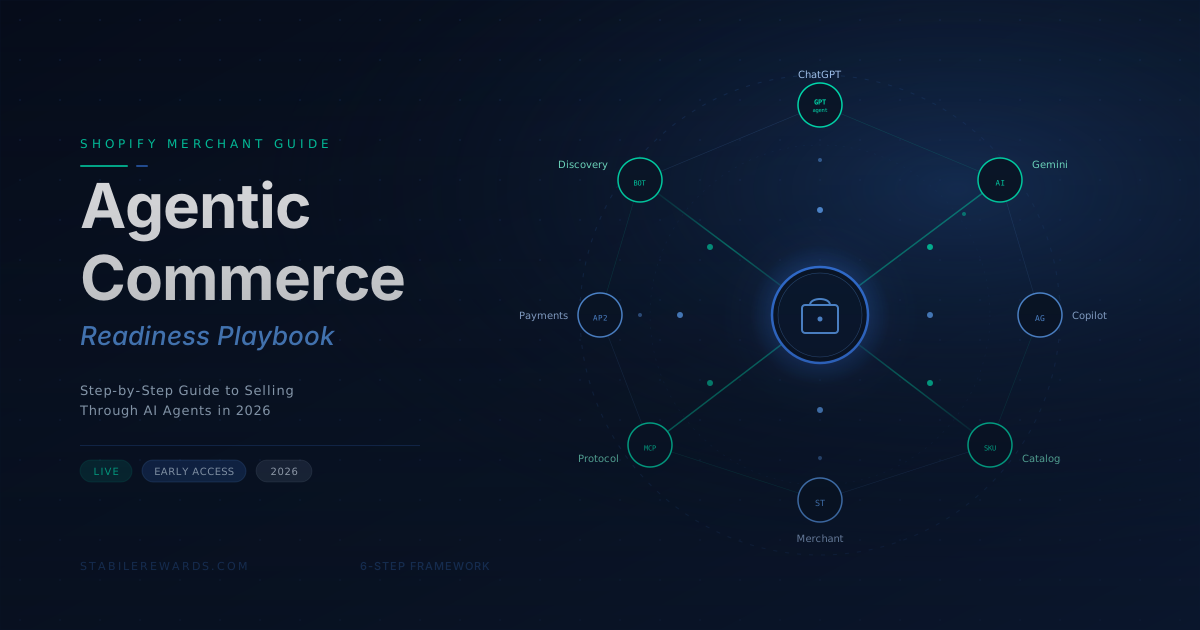
Agentic commerce is shifting online retail from a click-first web to an execution-first web. Instead of only browsing websites, shoppers increasingly use AI assistants to compare options, make decisions, and complete purchases.
For Shopify merchants, that means your storefront is no longer just a visual destination. It is also machine-readable infrastructure that must be accurate, structured, and reliable.
This playbook is for Shopify operators and digital leads who want a practical readiness plan. No engineering background is required.
The Agentic Readiness Stack
- Product Data: clear, attribute-rich descriptions
- Structured Metadata: metafields and schema markup
- Brand Knowledge: accurate policy and FAQ knowledge
- Access and Governance: bot permissions and crawlability
- Transactional Logic: payment and checkout reliability
- Ongoing Measurement: operational KPIs and iteration
Step 1: Audit Catalog Content for Machine Readability
Outcome: Agents can compare your products confidently.
Agents prioritize verifiable facts over vague adjectives. If your listings are ambiguous, your products are more likely to be skipped.
Merchant Checklist
- Rewrite priority SKUs using a Fact-Feel-Proof structure: objective facts first, then value narrative, then proof points.
- Replace soft claims with measurable specs (dimensions, capacity, charging speed, materials, compatibility).
- Add variant-level facts where decisions differ by size, color, fit, or model.
Step 2: Build a Consistent Metafield and Schema Layer
Outcome: Agents can filter and match products with high precision.
Descriptions help people. Metafields and schema help machines.
Merchant Checklist
- Define core product metafields (for example: material, fit, use_case, compatibility).
- Ensure variant-level offer data is exposed so agents do not recommend unavailable options.
- Add or validate FAQ schema on key PDPs to reduce pre-purchase friction.
Step 3: Maintain Accurate Brand Knowledge
Outcome: Agents answer questions using your approved policies.
Your shipping, returns, warranty, and eligibility rules should be easy for assistants to retrieve and apply correctly.
Merchant Checklist
- Keep policy content current and internally consistent across pages.
- Maintain a clear FAQ source of truth and review what customers ask most.
- Validate generated answers regularly and correct policy drift quickly.
Step 4: Enable Agentic Channel Readiness
Outcome: Your products are buyable in AI-assisted shopping flows.
As AI channels expand, readiness depends on both eligibility and clean operational data.
Merchant Checklist
- Verify eligibility and setup status for relevant agentic sales channels.
- Confirm policy pages are published and accessible.
- Ensure checkout prerequisites are fully configured.
- Track channel attribution so AI-assisted revenue can be measured separately.
Step 5: Configure Bot Access and Protection Correctly
Outcome: You block abuse without blocking discovery.
Many stores unintentionally block legitimate AI crawlers while trying to prevent malicious scraping.
Merchant Checklist
- Review
robots.txtdirectives for known AI discovery bots. - Confirm security settings do not throttle legitimate agentic traffic.
- Re-test crawl behavior after theme, app, or CDN rule changes.
Step 6: Tighten Transaction Trust Signals
Outcome: Fewer checkout failures and higher autonomous execution confidence.
Agent-assisted checkout depends on accuracy and consistency from browse to payment.
Merchant Checklist
- Keep product pricing synchronized across listing and checkout surfaces.
- Maintain real-time inventory accuracy at variant level.
- Remove manual-offline steps that break one-flow execution.
Common Failure Modes
- Attribute ambiguity: marketing language without measurable facts.
- Inventory opacity: missing or stale variant availability.
- Flow breaks: manual steps such as call-to-order or quote-only shipping.
- Discovery blockage: permissive storefront content but restrictive crawl settings.
90-Day Roadmap
Days 0-30: Data Integrity
- Audit top revenue SKUs
- Rewrite product data for machine readability
- Establish baseline metafields
Days 31-60: Trust and Knowledge
- Normalize policy and FAQ content
- Validate schema output on high-traffic PDPs
- Audit bot access settings
Days 61-90: Channel Launch and Optimization
- Enable eligible agentic channels
- Track AI-assisted traffic and conversion performance
- Iterate catalog and policy quality from observed failure points
KPIs That Matter in Agentic Commerce
- Agent-assisted order volume share
- Conversion delta between AI-assisted and traditional sessions
- Checkout failure rate in AI-assisted flows
- Operational time saved on support and catalog maintenance
Traditional engagement metrics like time-on-site become less useful when intent is resolved upstream by AI assistants.
Final Takeaway
Winning in agentic commerce is less about visual merchandising and more about operational truth. Merchants that expose clean data, accurate policies, and reliable transaction logic will be easier for AI agents to trust and recommend.
If your store is machine-readable, policy-consistent, and execution-ready, you are already ahead.