Resilient Loyalty Programs for the Age of Agentic Commerce


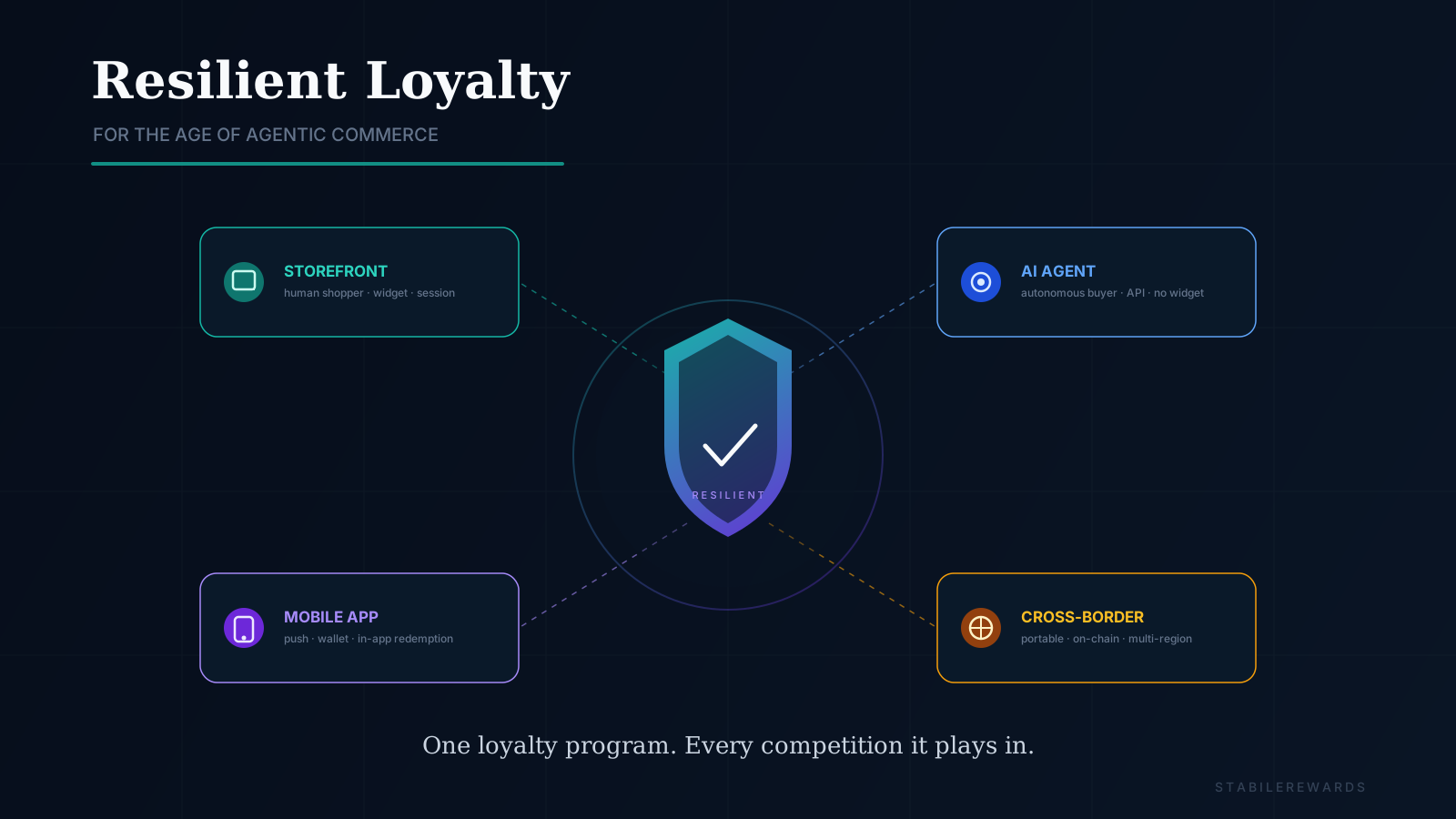
Direct Answer When commerce happens through AI agents, loyalty programs built for a single channel — a storefront, an email, a mobile app — become invisible. Resilient loyalty is different: it works across every environment where a purchase decision happens. That means AI-readable reward structures, automated eligibility checks, and redemption workflows that complete without a human clicking through a widget. The merchants best positioned for agentic commerce are not the ones with the most elaborate points programs. They are the ones whose loyalty value an AI agent can find, interpret, and apply.
Lionel Messi no longer plays in Europe's major domestic leagues, yet he remains one of the world's most impactful players.
Kylian Mbappé continues to face scrutiny and controversy at the club level, yet remains central to France's national team ambitions.
Why do elite players continue to succeed across such different environments?
Because their capabilities transfer.
Great Players Travel Across Competitions
A player may compete in:
- MLS
- La Liga
- Premier League
- Champions League
- FIFA World Cup
The environments differ dramatically. Squad depth, tactical systems, fixture density, opposition quality, travel schedules — all of it changes across competitions.
But the best players continue to perform because their skills are durable. They do not stop being effective when the format changes.
Messi's reading of space works the same way in Kansas City as it did in Barcelona. Mbappé's acceleration is just as decisive on an international stage as in a domestic sprint.
The competition changes. The underlying capability does not.
Loyalty Programs Face the Same Challenge
Most loyalty programs were designed for exactly one environment:
- A website a customer visits
- An email that gets opened
- A mobile app that gets downloaded and eventually ignored
The mechanisms are familiar: earn points, see a balance, redeem a reward at checkout, repeat.
That model worked when every commerce journey started with a human browsing a storefront.
But commerce is changing — and the new format rewards a different set of capabilities.
AI agents are beginning to discover products, compare offers, evaluate rewards, and make purchases on behalf of consumers. The shopper may never visit the storefront at all. They may simply ask an assistant to find the best option, apply any available rewards, and complete the purchase.
The question is no longer:
"Does my loyalty program work for customers?"
The new question is:
"Does my loyalty program work when an AI agent is doing the shopping?"
For most loyalty programs, the honest answer is no.
What Makes a Loyalty Program Fragile?
Traditional loyalty infrastructure has a structural problem that only becomes visible when the commerce channel changes.
Points live inside a platform. Balances are surfaced in a widget. Redemption requires a storefront session. The entire system assumes a human is present to navigate it.
When that assumption breaks — when an AI agent handles the discovery, comparison, and checkout without a person clicking through a website — the loyalty system becomes invisible. The agent cannot see the balance. It cannot evaluate eligibility. It cannot apply a reward during checkout.
The result is predictable:
- The customer loses the benefit they earned
- The merchant loses the competitive signal their loyalty program should have provided
- The agent selects a competitor on price or availability alone
This is not a problem with the customer. It is a problem with the architecture.
A loyalty program that only activates when a human opens a widget is not durable. It is channel-dependent — useful in one context, invisible in another.
The New Test of Loyalty Infrastructure
Future loyalty programs must work across multiple environments simultaneously:
- Human shoppers browsing a storefront
- AI shopping agents acting on a customer's behalf
- Cross-border buyers with different currency and eligibility rules
- Autonomous purchasing flows that complete without manual intervention
An AI agent evaluating a merchant needs to answer four questions about that merchant's loyalty program:
- Is this customer a member? Identity must be verifiable without a storefront session.
- What have they earned? Balance information must be accessible in a structured, readable format.
- What can they use? Eligibility rules must be machine-interpretable — not buried in a PDF.
- Can the reward be applied? Redemption must be executable during the transaction, not after.
If any of those four questions cannot be answered, the loyalty program does not participate in the agentic purchase decision. The customer's accumulated value disappears from the comparison.
Human vs. Agent: What Loyalty Infrastructure Must Handle
| Requirement | Human shopper | AI shopping agent |
|---|---|---|
| Balance visibility | Storefront widget, email, app | Structured API or protocol response |
| Eligibility check | Browse a FAQ or terms page | Machine-readable eligibility rules |
| Reward calculation | See a discount preview at cart | Automated valuation before checkout |
| Redemption | Click a button, enter a code | Automatic application during transaction |
| Attribution | Order history, email receipt | Channel-level order attribution |
The gap between columns two and three is where most existing loyalty programs fail.
They were built to serve column two. When column three shows up, they have nothing to offer.
Building Resilient Loyalty Programs
A resilient loyalty program is not just a program with more features.
It is a program designed from the start to work regardless of who — or what — is doing the shopping.
StabileRewards is building loyalty infrastructure designed for both humans and AI. The capabilities that make a program resilient include:
AI-readable rewards. Reward structures expressed in a format that an AI agent can parse and evaluate — not buried inside a visual widget that only renders in a browser.
Automated reward valuation. The ability to calculate the real monetary value of a reward before a transaction begins. A $100 product with a $15 usable reward is a different offer than a $100 product alone. That difference should be visible to the agent making the comparison.
Agent-to-agent eligibility checks. When an AI shopping agent evaluates a merchant, it should be able to verify whether a customer qualifies for a reward without requiring a storefront visit or manual confirmation.
Automatic redemption workflows. The reward should apply during checkout without requiring the customer to click a widget, enter a code, or navigate to a separate interface. Redemption needs to be executable in an autonomous flow.
Cross-border reward portability. Commerce is global. A loyalty program that only works inside one storefront region is limited by geography in the same way it is limited by channel. Resilient loyalty travels with the customer across borders.
Blockchain-backed reward records. On-chain reward issuance means the customer's earned value exists independently of any single merchant's database. It is verifiable, portable, and durable — not subject to the same risks that erased Free Spirit members' points when Spirit Airlines shut down in May 2026.
Resilience in Practice
Consider two Shopify merchants selling the same product at the same price.
Merchant A has a loyalty program. When a human customer visits the storefront, they can see their points balance and apply a reward at checkout. But when a ChatGPT shopping agent evaluates the merchant on behalf of a customer, the agent cannot see the loyalty balance. It cannot calculate the effective discount. It evaluates on price and availability alone.
Merchant B has a resilient loyalty program. When the same agent evaluates Merchant B, it can retrieve the customer's reward balance, calculate that a $12 reward applies to this order, and present Merchant B as the better value — even though the list price is identical.
The customer's effective cost with Merchant B is $88. With Merchant A, it appears to be $100.
The agent chooses Merchant B.
Merchant A's loyalty program did not fail because the rewards were wrong. It failed because the rewards were invisible.
From Useful to Durable
A striker who performs in only one league is valuable.
A striker who performs in every competition — domestic league, cup, Champions League, World Cup — becomes legendary.
The difference is not talent alone. It is adaptability: the ability to produce the same output across different formats, opposition levels, and pressure environments.
Likewise, a loyalty program that works only on websites is useful.
A loyalty program that works across websites, AI agents, marketplaces, and future commerce channels becomes durable.
Football is still football.
Commerce is still commerce.
But the competitions are changing.
The organizations that prepare for the next tournament — the agents, the autonomous buyers, the cross-border flows that do not require a human to visit a storefront — will be the ones best positioned to win it.
Resilient loyalty is how merchants stay on the pitch.
Frequently Asked Questions
What is a resilient loyalty program?
A resilient loyalty program is one that works across multiple commerce environments — not just a single storefront or mobile app. In agentic commerce, this means AI agents can read reward balances, check eligibility, calculate reward value, and apply redemptions automatically during checkout, without a human navigating a widget.
Why can't AI shopping agents use traditional loyalty programs?
Most loyalty programs store balances inside a storefront widget and require a human to log in, browse, and click to redeem. AI shopping agents operate without a browser session or user interaction. If loyalty information is not available in a structured, machine-readable format, the agent cannot see it — and the customer's earned value does not factor into the purchase decision.
How does an AI agent calculate loyalty value during a purchase?
A machine-readable loyalty system exposes the customer's balance, applicable reward value, and eligibility rules in a structured response. The agent can then include that reward in the total cost comparison — treating a $100 product with a $15 reward as an effective $85 offer, rather than comparing it at face price against a competitor.
What is the difference between portable loyalty and closed-loop loyalty?
Traditional closed-loop loyalty ties rewards to a single merchant's systems. If the merchant closes, the rewards disappear — as happened to Free Spirit members when Spirit Airlines shut down in 2026. Portable loyalty, backed by stablecoin settlement and open protocols, gives the customer's earned value an existence independent of any single issuer.
Do I need to rebuild my loyalty program from scratch to support AI agents?
Not necessarily. StabileRewards is designed to work alongside Shopify's existing order and customer data. The goal is to make your existing loyalty value visible and usable in AI-assisted commerce channels — not to replace what you have already built.
What is the Universal Commerce Protocol and why does it matter for loyalty?
The Universal Commerce Protocol (UCP) is an open standard that allows AI shopping agents, merchants, and commerce platforms to exchange structured data — including loyalty information — without custom integrations for every connection. StabileRewards uses UCP-compatible infrastructure so that loyalty value can travel across platforms as the agentic commerce ecosystem develops.
Get started
Make your loyalty program resilient — across every channel where your customers shop.
StabileRewards helps Shopify merchants make rewards visible and usable in AI-assisted shopping, from product discovery through checkout.
Free to install · Pay on results: 1% of reward value redeemed + $0.05 per AI-channel transaction · No charge if no rewards applied.
Install from the Shopify App Store →
StabileRewards Blog — AI-Powered, Blockchain-Secured Loyalty for Agentic Commerce.