The Composure Quotient: Why Agentic Commerce Demands More Than Inventory


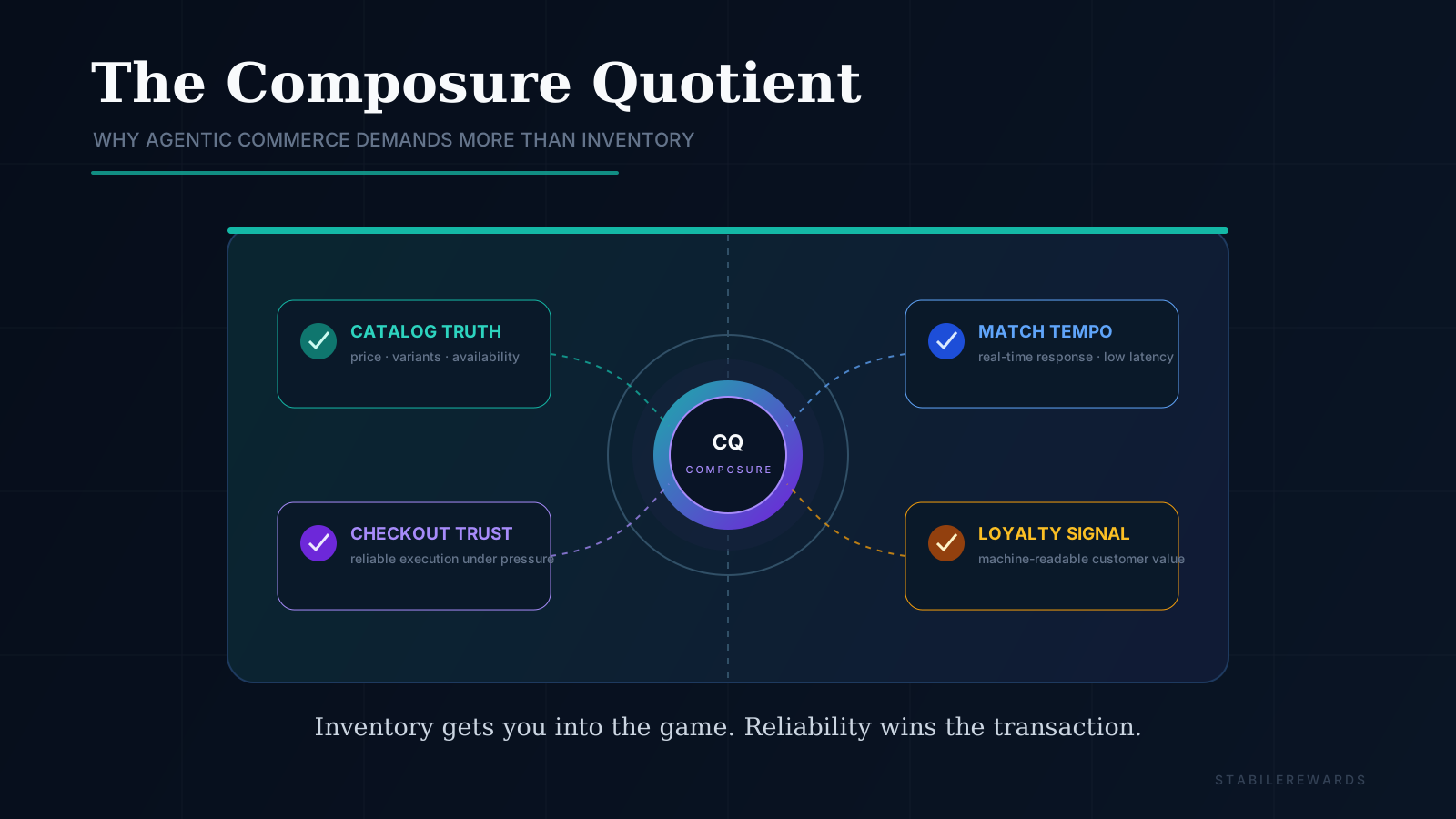
Direct Answer In agentic commerce, inventory is necessary but not sufficient. AI shopping agents need confidence that a merchant's product data, pricing, availability, checkout, and loyalty rules will remain accurate from recommendation through purchase. The Composure Quotient is a way to describe that operational reliability. For Shopify merchants serving demand around the 2026 FIFA World Cup, composure means staying machine-readable, responsive, and transaction-ready when a goal, upset, or qualification result sends global demand surging in seconds.
In elite football, composure is what keeps a promising attack from collapsing under pressure.
It is the extra touch that opens a passing lane. The scan before receiving the ball. The ability to make the same good decision in the 89th minute that looked easy in the ninth.
Players such as Lamine Yamal and Jude Bellingham are celebrated for talent, but talent alone does not explain their influence. Their real advantage is the ability to process a crowded field and execute reliably while the game accelerates around them.
Shopify merchants are entering a version of that same test.
The 2026 FIFA World Cup creates 104 matches across 16 host cities, with every match capable of producing a sudden wave of searches, recommendations, purchases, and reward activity. At the same time, AI assistants are becoming participants in the shopping journey—not merely helping people browse, but comparing offers and acting on purchase intent.
In that environment, being in stock gets a merchant into the game.
Composure determines whether the transaction survives the pressure.
What Is the Composure Quotient in Agentic Commerce?
The Composure Quotient is a practical measure of whether a store remains trustworthy when an AI agent moves from discovery to execution.
It asks four questions:
- Is the catalog true? Product attributes, variants, prices, and availability agree across every surface.
- Does the store respond in time? Product and checkout systems remain fast enough for an agent to complete its task.
- Will the transaction finish as promised? Shipping, discounts, taxes, inventory, and payment logic do not change unexpectedly mid-flow.
- Can the agent understand the customer's value? Loyalty eligibility and rewards are available in a structured, usable form.
This is different from a conventional storefront-readiness checklist. A human shopper may tolerate a stale badge, refresh a page, reinterpret a vague policy, or try another discount code. An autonomous shopping flow is less forgiving. When facts conflict or execution fails, the agent can choose another merchant.
That makes composure a trust signal.
Why Is the 2026 World Cup an “Algorithmic Stadium”?
The World Cup compresses global attention into a continuous sequence of unpredictable moments.
A goal changes the player everyone wants on a shirt. An upset changes travel plans. A knockout result creates demand in one country and ends it in another. A breakout performance can turn an ordinary product into a viral item before a traditional campaign is approved.
Fans react immediately. AI-assisted commerce makes that reaction even faster.
A shopper can ask an assistant to find an in-stock jersey in the right size, compare delivery dates, apply an available reward, and select the best total offer. The agent may evaluate several stores without experiencing any of them as a visual destination.
For that agent, a Shopify storefront is also a set of machine-readable claims:
- this variant exists
- this price is current
- this delivery date is achievable
- this reward is valid
- this checkout will complete
The merchant that can keep those claims true under match-day pressure has composure. The one that cannot may disappear from consideration before a human ever sees its homepage.
How Do Athlete Traits Translate Into Commerce Reliability?
| Athlete trait | Commerce equivalent | Agentic benefit |
|---|---|---|
| Field vision | Accurate, predictive inventory signals | Agents can select available variants and avoid dead ends |
| Match tempo | Low-latency catalog and checkout responses | Autonomous purchase flows complete before facts change |
| Composure | Transactional reliability under demand spikes | The offer remains valid from recommendation to payment |
| Team chemistry | Connected catalog, checkout, and loyalty systems | Customer value carries across the whole buying journey |
The important distinction is that inventory is only one part of field vision. A product marked “available” is not useful if the size is wrong, the delivery promise is stale, or the reward disappears at checkout.
Agentic reliability is end-to-end reliability.
Why Must Loyalty Move Beyond a Static Points Ledger?
Traditional loyalty programs wait for the customer to enter the storefront.
The shopper logs in, notices a points balance, opens a rewards widget, and decides whether to redeem. That model assumes the customer—not an agent—is assembling the offer.
Event-driven loyalty works differently. It responds to the moment and makes the resulting value available wherever the purchase decision happens.
Around a tournament, that could include:
- Dynamic drops: release a limited product when a defined match event occurs.
- Virtual passports: award stamps for participation across matches, campaigns, or merchant experiences.
- Outcome-triggered rewards: unlock a benefit when a team advances or a fan completes a challenge.
- Agent-readable loyalty: expose eligibility, value, and redemption rules so an AI assistant can use the reward during checkout.
The first three create excitement. The fourth makes that excitement operational.
If an offer exists only inside an app screen or marketing email, an AI agent may never know it is available. Machine-readable loyalty turns the reward from a message into a decision signal.
That signal can help an agent answer a commercially important question: why should this customer buy from this store now?
What Does a Composed Shopify Store Look Like?
A composed store does not need to predict every match result. It needs infrastructure that can absorb the result without losing its shape.
Before the traffic spike
- Validate titles, variants, availability, pricing, and delivery information across high-demand products.
- Make returns, shipping, and promotion rules explicit enough for an agent to interpret.
- Review crawler access and storefront protections so legitimate AI discovery is not blocked accidentally.
- Define event-triggered campaigns before kickoff, including inventory limits and fallback behavior.
During the traffic spike
- Monitor product, cart, checkout, and loyalty response times—not only homepage uptime.
- Keep inventory synchronized at the variant level.
- Confirm that discounts and rewards resolve consistently across channels.
- Preserve attribution for AI-assisted orders so demand can be measured later.
After the moment
- Compare what agents and shoppers were promised with what the store delivered.
- Review checkout failures, oversells, reward errors, and support contacts.
- Update product and policy data where agents encountered ambiguity.
- Carry newly earned loyalty value into the next event rather than ending the relationship at the sale.
Composure is not the absence of volatility. It is the ability to remain accurate while volatility happens.
How Can Merchants Measure Their Composure Quotient?
Start with a small scorecard. Track the systems an agent depends on rather than relying only on traffic and conversion totals.
| Dimension | What to measure |
|---|---|
| Catalog truth | Price mismatches, stale variants, and oversell rate |
| Response | Catalog, cart, and checkout latency at peak load |
| Execution | Checkout completion and payment failure rates |
| Loyalty continuity | Reward recognition, application, and attribution rates |
The score is not a vanity benchmark. It reveals where a store loses trust between “the item exists” and “the purchase succeeded.”
The Bottom Line
The 2026 World Cup is a global stress test for real-time commerce.
Every match creates new information. Every new piece of information can redirect attention and purchase intent. AI agents make the distance between those two moments shorter.
The merchants that win will not simply be the ones holding inventory. They will be the ones whose systems remain accurate, legible, and executable when the agent asks for the ball.
That is the Composure Quotient: the ability to turn pressure into a completed, trustworthy transaction.
Frequently Asked Questions
What is the Composure Quotient in ecommerce? The Composure Quotient is a framework for evaluating whether a store's catalog, APIs, checkout, and loyalty systems remain accurate and reliable under pressure. It focuses on the complete transaction, not inventory alone.
Why is inventory not enough for AI shopping agents? An in-stock signal does not guarantee a successful purchase. Agents also need reliable variant data, current prices, clear shipping rules, responsive systems, valid rewards, and a checkout that completes as promised.
How does the 2026 FIFA World Cup affect Shopify merchants? The tournament concentrates global attention into 104 live events. Match outcomes can trigger rapid changes in demand for merchandise, travel, collectibles, and fan experiences, making it a useful stress test for real-time commerce infrastructure.
What is agent-readable loyalty? Agent-readable loyalty presents reward eligibility, balances, value, and redemption rules in a structured form that an AI shopping assistant can understand and use during a purchase decision.
What should a Shopify merchant test before a major match day? Test variant-level inventory, price consistency, product and checkout latency, shipping promises, promotion logic, reward application, crawler access, and AI-channel attribution under expected peak load.
How does StabileRewards help with agentic commerce readiness? StabileRewards helps Shopify merchants make loyalty easier for AI shopping channels to understand, attribute AI-assisted orders, and apply rewards in agentic buying journeys. That turns loyalty from a storefront-only feature into a machine-readable reason to choose the store.
Get started
Give your loyalty program the composure to perform under pressure.
StabileRewards helps Shopify merchants make rewards visible and useful in AI-assisted shopping—so customer value stays in the play from product discovery through checkout.
Free to install · Pay on results: 1% of reward value redeemed + $0.05 per AI-channel transaction · No charge if no rewards applied. Install from the Shopify App Store →
StabileRewards Blog — AI-Powered, Blockchain-Secured Loyalty for Agentic Commerce.