What It Looks Like When ChatGPT Shops at a Candle Store


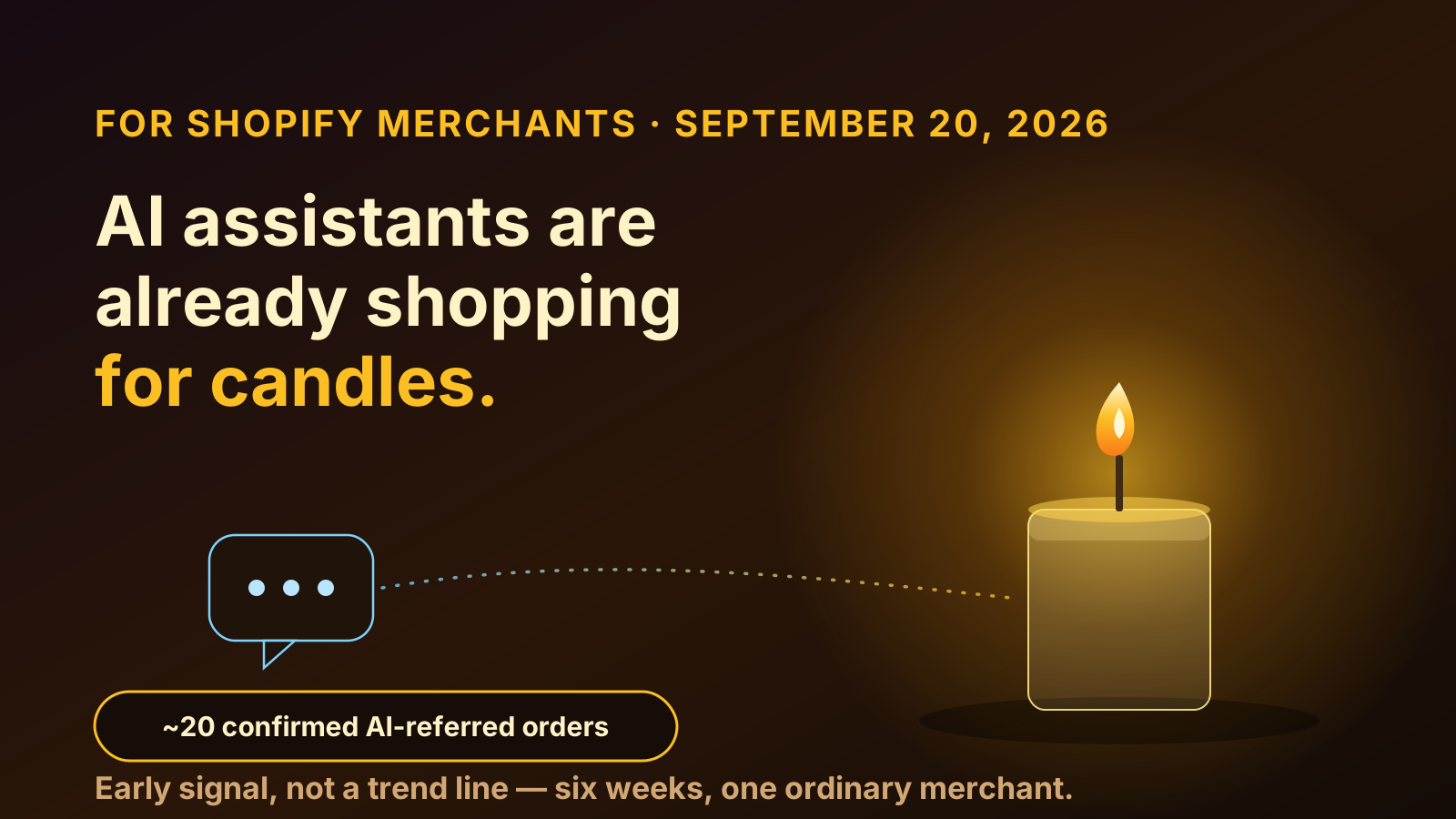
Direct Answer Over a recent six-week window, one ordinary StabileRewards merchant — a home fragrance and body-care brand — had about 20 individually confirmed orders referred by AI shopping assistants: roughly 18 from ChatGPT, 2 from Microsoft Copilot. These are real, completed, paid orders, not projections or simulated traffic. We can't yet tell you exactly what happened upstream of each click, and we're not calling this a growth trend or crediting our loyalty program for producing these specific orders — only that AI-referred purchases are already reaching stores nobody would think to test for this.
When people talk about AI shopping assistants, the examples tend to be the obvious ones: laptops, headphones, sneakers from a household-name brand. So we were a little surprised by what we found when we looked at the orders coming through one of our merchants.
They sell candles, room sprays, diffusers, body scrubs, and seasonal scent collections — a home fragrance and body-care brand, the kind of small, ordinary DTC shop most people assume is invisible to anything more sophisticated than a Google search.
Candles. Bought via ChatGPT.
What's actually provable here, and what isn't
Here's what we can say with confidence. Over that six-week window, this merchant had about 20 orders that Shopify's own order data identified as referred by an AI platform: about 18 from ChatGPT and 2 from Microsoft Copilot. Each was individually confirmed. These are real, completed, paid orders.
Here's what we're deliberately not saying. We don't know exactly what happened upstream of each of those clicks — whether the assistant was citing the product from its own web index, answering a direct question about the brand, or something else. We can't trace a specific AI session back to a specific mechanism with certainty, and we're not going to pretend otherwise.
This also isn't a growth story. Twenty orders in six weeks is not a dominant sales channel. We're not attaching a revenue figure or a percentage lift to it, and no one should read it that way.
Think of it as an early signal, proof of life. AI assistants are already finding and buying from small, unglamorous brands, quietly, without anyone making a fuss about it.
Why a store like this can be visible at all
Separate from what happened in these specific orders, here's a general fact worth knowing: an AI assistant doesn't need anything elaborate to understand what a store sells and what a customer gets for shopping there — no redesign, no custom integration, no team that understands how these systems work. A public, readable rewards or loyalty program, in plain language, is enough for that information to be legible to an assistant that goes looking for it. No special setup required on the merchant's end.
This particular merchant has been with StabileRewards for about four months, on our flat-fee loyalty plan. Nothing about their setup is exotic — which is the point. We're not claiming their program is what produced these 20 orders specifically. We're saying the bar for being legible to an AI assistant, in general, is lower than most merchants assume.
What we checked, and what we still can't prove
We also went looking for a stronger claim than the one above, and didn't find it.
We track, separately, when an AI crawler or assistant actually reads a store's public program data. We checked that signal across every merchant we have it for, looking for a case where we could see both that reading happen and a resulting AI-referred order land — the two halves that would let us say "this is why it happened," not just "it happened." We don't have that pairing yet, for this merchant or any other. Plenty of stores show one signal or the other. None show both together, so far.
That's a real limitation, and we'd rather say it here than let the mechanism section above imply more than it can support.
Why this matters for merchants like this one
If you sell home goods, candles, body care, or anything in neighboring lifestyle categories, the takeaway isn't "AI is about to transform your revenue." It's smaller and more practical: the door is already open, and not many people are standing in it yet.
Right now, being visible to AI shopping assistants is uncrowded and easy. Later, as more merchants notice and more shoppers hand off more of their browsing, it will take more effort to stand out. The brands that are already legible to these assistants when that happens won't have to catch up.
Get started
If you're running a shop in this space and want to see what this could look like for your store:
Install StabileRewards from the Shopify App Store ->
Free to install · Pay on results: 1% of reward value redeemed + $0.05 per AI-channel transaction · No charge if no rewards are applied.
Questions, or want to compare notes on what you're seeing in your own analytics: get in touch or email support@stabilerewards.com.