The Billion-Dollar Whistle: Why Modern Sports Can't Escape Money and Politics


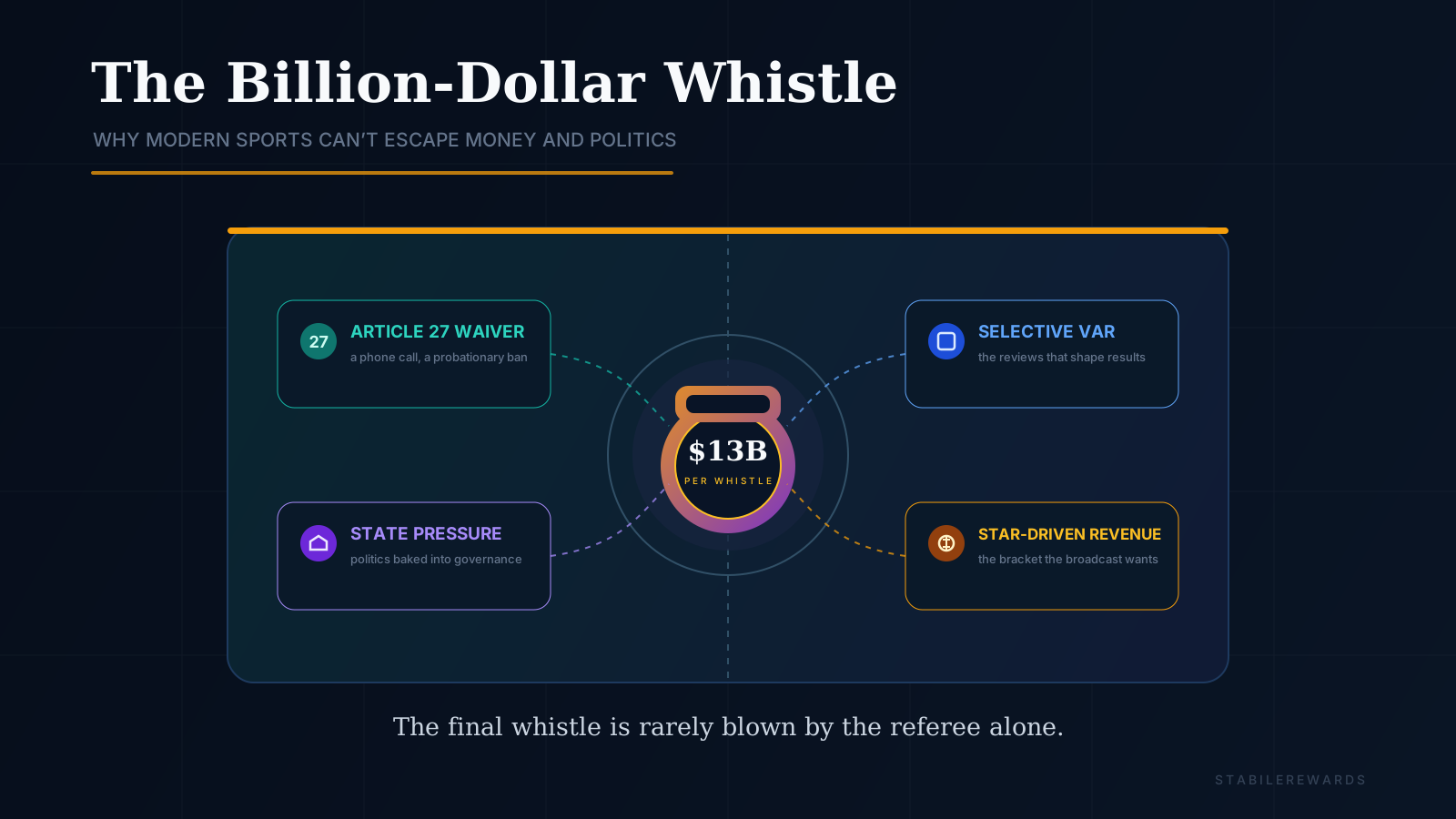
Direct Answer In a single 48-hour stretch of the 2026 FIFA World Cup knockout rounds, two flashpoints collided: FIFA lifted U.S. forward Folarin Balogun's automatic red-card suspension after President Donald Trump personally called FIFA President Gianni Infantino — invoking a rarely used probationary provision in Article 27 of its disciplinary code — and Egypt surrendered a 2-0 lead to lose 3-2 to defending champions Argentina under officiating its federation formally protested. Neither incident proves a fix. Together, they prove something larger: elite sport is a multi-billion-dollar entertainment product operating under constant commercial and political pressure, and modern fans need to watch it with clear eyes.
The knockout rounds of the 2026 FIFA World Cup will be remembered for generations, but perhaps not for the reasons football purists would prefer. Within a 48-hour span, the tournament delivered two explosive flashpoints that shattered any illusion that elite sports exist in a vacuum separate from the realities of geopolitical power and corporate revenue.
First, there was the extraordinary White House intervention. After U.S. forward Folarin Balogun was shown a red card for a challenge on Tarik Muharemović in the Round of 32 win over Bosnia and Herzegovina, President Donald Trump personally called FIFA President Gianni Infantino to ask for a review of the card and the automatic one-match ban that came with it. Days later, FIFA invoked a rarely used provision in Article 27 of its disciplinary code — suspending implementation of the ban "for a probationary period of one year" — and cleared Balogun to face Belgium in the Round of 16.
Immediately following that drama came the scorched-earth fallout in Atlanta. Egypt sat on the precipice of an all-time great World Cup upset, holding a commanding 2-0 lead over defending champions Argentina. But a series of highly contentious decisions overseen by French referee François Letexier — a Mostafa Ziko goal disallowed after a VAR review found a foul on Lisandro Martínez in the buildup, a waved-away penalty appeal for an Alexis Mac Allister shirt-pull on Hamdy Fathy, and an alleged unpunished foul on Mohamed Salah in the move that produced Enzo Fernández's stoppage-time winner — preceded a furious 3-2 Argentinian comeback. The Egyptian Football Association has since filed a formal complaint, saying it "cannot remain silent" over the refereeing decisions and the use of VAR, while Egypt coach Hossam Hassan told reporters: "Perhaps they wanted to keep the world champion in the competition. Perhaps they wanted Messi to stay in the running."
Predictably, the internet has fractured. Fans are locked in endless loops debating VAR angles, parsing the exact wording of the FIFA disciplinary code, and trading tribal insults. But if we pull our focus back from the specific refereeing decisions or the political actors involved, a much larger, more grounded truth emerges: modern football — and indeed, any major global sport — is no longer just an athletic competition. It is a multi-billion-dollar entertainment product heavily leveraged by money and politics.
What Actually Happened: Two Flashpoints in 48 Hours
| Flashpoint | What happened | The fallout |
|---|---|---|
| The Balogun waiver | Red card vs. Bosnia in the Round of 32; Trump called Infantino; FIFA suspended the ban under Article 27 for a one-year probationary period | Belgium's federation challenged Balogun's eligibility; UEFA called the decision "unprecedented, incomprehensible and unjustifiable" and said FIFA had "crossed a red line" |
| Egypt vs. Argentina | Egypt led 2-0 in Atlanta; a disallowed goal, a denied shirt-pull penalty, and a contested buildup to the stoppage-time winner fueled a 3-2 Argentina comeback | The Egyptian FA filed a formal complaint over the officiating and VAR use; coach Hossam Hassan publicly suggested FIFA wanted Messi to stay in the tournament |
Neither row of that table, on its own, is proof of anything beyond human error and institutional flexibility. Read together, in the same 48 hours, they explain why so many neutral fans reached the same cynical conclusion at the same time.
How Does Star-Driven Revenue Pressure the Product?
Elite sports operate inside enormous financial gravity. For the 2023–2026 cycle, FIFA projected total revenues to top $13 billion, driven by broadcast rights, corporate sponsorships, ticket sales, and premium hospitality.
When the stakes are that high, there is immense, quiet pressure to protect the "product." A World Cup bracket containing Lionel Messi in the quarter-finals is inherently more valuable to broadcasters, advertisers, and casual viewers than one without him. When Hossam Hassan speculated aloud that FIFA "wanted Messi to stay in the running," he was giving voice to a cynicism shared by millions of neutral fans.
To be fair to the officials, every contested decision in Atlanta came with a stated rationale — the disallowed goal, for instance, was ruled out for a foul in the buildup, and Egypt's own second-half collapse did the rest. But that is precisely the point: when selective VAR reviews and highly subjective officiating appear to align, again and again, with the outcome that protects tournament revenue, public skepticism is a completely logical byproduct. The commercial machinery rewards the survival of the narratives that sell tickets and command prime-time television slots — and it never has to ask anyone to do anything for suspicion to take root.
Where Do Politics and Sports Governance Blur?
The Balogun waiver put a spotlight on another uncomfortable reality: the entanglement of state power and sports governance. Organizations like FIFA promote a strict policy of political non-interference, yet they operate on a global diplomatic stage where they must constantly negotiate with heads of state and powerful host countries.
When an executive branch publicly pressures a sports federation — and the federation visibly bends — it exposes the fragile nature of sports autonomy. Trump himself confirmed the call, telling reporters, "I asked for a review because I didn't think it was a foul," and later praised the outcome as a "really brilliant decision." Critics online immediately compared the dynamic to the infamous 1934 World Cup in Mussolini's Italy, noting that bending tournament frameworks to accommodate host-nation leaders is a pattern as old as the game itself. Whether it is a government seeking a domestic public-relations boost or a sports body making concessions to protect lucrative institutional alliances, politics is thoroughly baked into the administrative framework of elite sports.
Is Sporting Meritocracy Under Threat?
For the everyday fan, the beauty of sports lies in its ultimate unpredictability and its strict adherence to a shared set of rules. The belief that on any given day, an underdog like Egypt can line up against a giant like Argentina and win purely on merit is what makes us watch.
However, when a sport grows into a heavily managed global entertainment spectacle, that purity is threatened. Overnight rule interpretations, selective VAR intervention, and administrative exceptions breed deep cynicism. When outcomes begin to feel engineered by forces off the pitch, the game loses the very thing that made it valuable in the first place.
The ultimate irony of the U.S. saga is that despite the unprecedented political intervention to get Balogun into the lineup, Team USA was still thoroughly dismantled 4-1 by Belgium. Balogun started and finished the match without a goal or an assist. The administrative chaos and the media circus surrounding the White House phone call ultimately served as a destabilizing distraction rather than an on-field advantage — a reminder that you can bend the rulebook and still lose the game.
The Modern Fan's Dilemma
The real takeaway from this chaotic stretch of the knockout rounds isn't about whether a specific red card was soft or a foul in the box was missed. It is a stark reminder of the terms of engagement for modern fandom.
We can still love the tactical brilliance on the field, the athletic genius of the players, and the raw emotion of a stoppage-time winner. But to watch elite modern sports cleanly, we must remain clear-eyed about the massive corporate and political machinery running it behind the scenes. On the grandest stage, the final whistle is rarely blown by the referee alone — it is heavily guided by the immense weight of money and power.
Trust, once spent, is expensive to rebuy. That is true for a governing body defending a probationary loophole, and it is true for any institution — sporting or commercial — that asks a global audience to believe its rules mean what they say.
Frequently Asked Questions
Why was Folarin Balogun's red-card suspension lifted at the 2026 World Cup? After Balogun was sent off in the Round of 32 win over Bosnia and Herzegovina, President Donald Trump called FIFA President Gianni Infantino to request a review. FIFA then invoked Article 27 of its disciplinary rules, which allows a judicial body to fully or partially suspend the implementation of a disciplinary measure, and suspended the one-match ban for a probationary period of one year — clearing Balogun to face Belgium.
What is Article 27 of the FIFA disciplinary rules? It is the provision under which a FIFA judicial body "may decide to fully or partially suspend the implementation of a disciplinary measure." It is rarely applied to automatic red-card suspensions at a World Cup, which is why UEFA, Belgium's federation, and former players called its use for Balogun unprecedented.
What were the contested decisions in Egypt vs. Argentina? Three moments drew formal protest: a Mostafa Ziko goal disallowed after VAR found a foul on Lisandro Martínez in the buildup; a waved-away penalty appeal for an Alexis Mac Allister shirt-pull on Hamdy Fathy; and an alleged unpunished foul on Mohamed Salah in the move leading to Enzo Fernández's stoppage-time winner in Argentina's 3-2 comeback.
Did the Egyptian Football Association file a complaint? Yes. The Egyptian FA said it "cannot remain silent" regarding the refereeing decisions and the failure to make appropriate use of VAR, and lodged a formal complaint with FIFA after the Round of 16 loss in Atlanta.
Did the political intervention help Team USA win? No. Despite Balogun's cleared suspension and a starting spot, the U.S. lost 4-1 to Belgium in the Round of 16 and was eliminated, with Belgium advancing to face Spain in the quarter-finals.
How much revenue does FIFA make from the World Cup cycle? FIFA projected total revenues exceeding $13 billion for the 2023–2026 cycle, driven by broadcast rights, sponsorships, ticketing, and hospitality — the commercial backdrop against which every high-stakes officiating and governance decision is inevitably judged.
Get started
Trust is the product — in sport and in commerce.
StabileRewards helps Shopify merchants keep their promises machine-readable and reliable in AI-assisted shopping, so the rules of your loyalty program always mean what they say — from discovery through checkout.
Free to install · Pay on results: 1% of reward value redeemed + $0.05 per AI-channel transaction · No charge if no rewards applied. Install from the Shopify App Store →
StabileRewards Blog — AI-Powered, Blockchain-Secured Loyalty for Agentic Commerce.