AI Shopping Ready vs AI Shopping Optimized vs AI Shopping Measurable


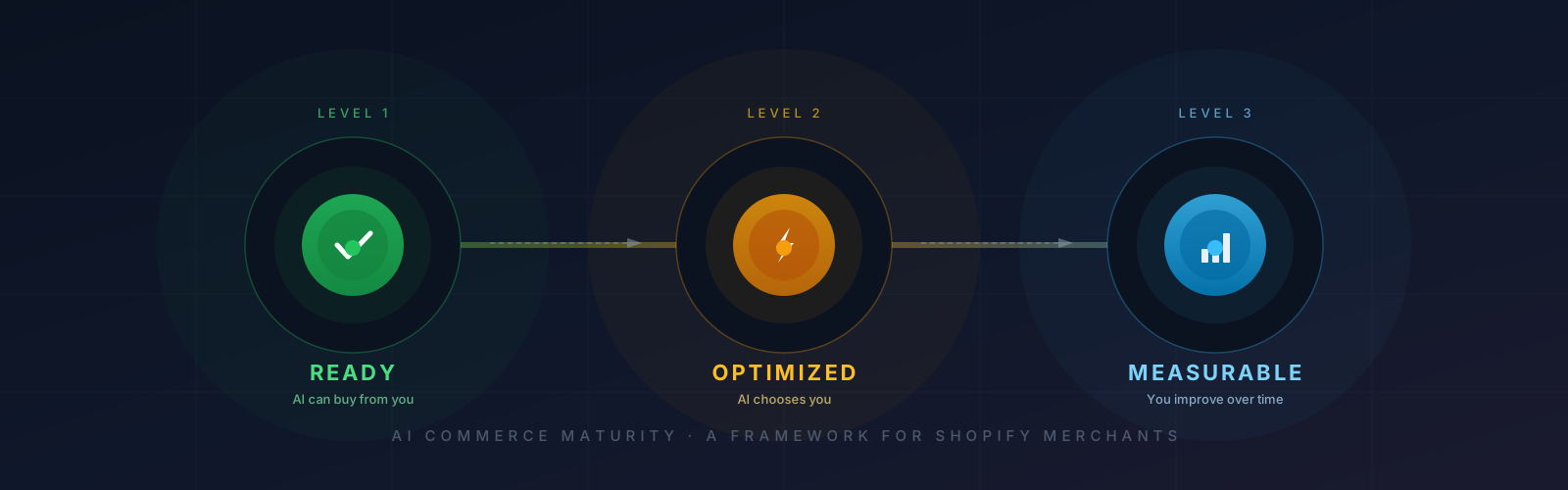
Direct Answer There are three levels of AI commerce maturity for Shopify merchants. Level 1 (Ready): AI can access and purchase your products — this is what Shopify Agentic Storefronts enables by default. Level 2 (Optimized): your product data is structured so AI recommends you over competitors. Level 3 (Measurable): you track AI-attributed orders, run optimization loops, and tie loyalty rewards to AI-referred customers. Most merchants are at Level 1. The opportunity is in Levels 2 and 3.
With the rise of AI shopping experiences—inside tools like ChatGPT, Google Gemini, and Microsoft Copilot—your Shopify store is no longer just competing on search rankings or ads.
It's now being interpreted by AI, selected by AI, and purchased through AI-assisted flows.
And that introduces a new question:
Is your store actually ready for AI shopping?
Most merchants assume: "If I'm integrated with Shopify's AI channels (Agentic Storefronts), I'm ready."
That's only partially true.
The Key Idea
Agentic Storefronts makes your store AI-accessible. AI shopping readiness means your store is AI-buyable.
And beyond that, there are two more layers most merchants miss entirely.
The 3 Levels of AI Commerce Maturity
🟢 Level 1 — AI Shopping Ready (Baseline)
Your store can be accurately discovered, understood, and purchased by AI agents.
This is the minimum bar.
What must be true
1. AI can access your products
- Your catalog is exposed to AI shopping channels
- Product pages are reachable and stable
- Price and inventory are available
👉 This is what Shopify's agentic infrastructure primarily enables. If you haven't set this up yet, see Shopify Agentic Storefronts Just Launched — Here's What It Means for Your Loyalty Program.
2. AI can understand what you're selling
- Product titles and descriptions contain enough meaning
- Variants are distinguishable (size, color, etc.)
- The agent can map user intent → correct product
This does not require perfect structure. It requires decision clarity.
3. AI can complete or hand off a purchase
- Product → cart → checkout flow works
- No broken or ambiguous purchase steps
- The agent can confidently proceed
What is NOT required at this level
- Perfect product taxonomy
- Fully structured attributes/metafields
- Rich use-case tagging
- Advanced analytics or attribution
- AI-specific merchandising
The real test
Could an AI assistant successfully buy the correct product for a user without making obvious mistakes?
If yes → you are AI shopping ready.
🟡 Level 2 — AI Shopping Optimized
Your store is structured to perform well in AI-driven discovery, recommendation, and conversion.
This is where competitive advantage starts.
What improves at this level
1. Better AI recommendations
AI is more likely to choose your product because it understands:
- use cases ("for travel", "for oily skin")
- audience ("men's slim fit", "beginner-friendly")
- benefits ("lightweight", "long-lasting")
2. Higher conversion confidence
AI can answer questions like:
- "Will this fit me?"
- "Is this good for X?"
- "What's the difference between these options?"
3. Fewer wrong purchases
Clearer variants, compatibility, and product distinctions → fewer returns and better customer experience.
What drives optimization
A. Decision clarity (not just "clean data")
- descriptive titles
- meaningful variant names
- key facts visible in text (not only visuals)
B. Recommendation signals
- use-case language
- audience fit
- comparisons and alternatives
- bundles / compatibility
C. Confidence signals
- shipping clarity
- returns clarity
- FAQs in plain language
Important nuance
These are not prerequisites. A store can be AI-ready without them.
But without them:
You may be present in AI shopping… but not competitive.
🔵 Level 3 — AI Shopping Measurable
You can track, analyze, and improve AI-driven commerce as a channel.
This is where AI shopping becomes a growth engine, not just a new surface.
What this unlocks
1. Attribution
- Which orders came from AI?
- Which products convert via AI?
2. Performance insights
- What types of queries lead to purchases?
- Where do AI-driven journeys fail?
3. Optimization loops
- adjust product data
- refine positioning
- improve conversion paths
4. Retention & loyalty
- reward AI-originated customers
- personalize follow-ups
- connect AI discovery → long-term value
Typical capabilities
- UTM / referral tracking for AI channels
- Order source tagging
- Analytics dashboards
- CRM / loyalty integration (e.g., rewards, incentives)
Important clarification
This level is not required to be AI shopping ready.
But without it:
You are flying blind.
The Most Common Misconception
❌ "AI is good at unstructured data, so optimization doesn't matter"
Partially true—but incomplete.
AI can interpret messy data. But commerce often requires precision, correct variant selection, correct recommendation, and a low error rate.
So the real dynamic is:
AI doesn't require perfect structure to function. But better decision clarity improves reliability and outcomes.
That does not mean AI needs rigid feed logic for everything. It means:
When a wrong recommendation or wrong variant has consequences, clearer product information helps AI make better decisions.
A Better Way to Think About It
Instead of asking "Is my store AI-ready?", ask:
- Can AI buy from me? → Ready
- Will AI choose me? → Optimized
- Can I improve performance? → Measurable
Where Most Shopify Merchants Are Today
- Many are reaching Level 1 (Ready) via Shopify's AI integrations
- Few are at Level 2 (Optimized)
- Very few are at Level 3 (Measurable)
That gap is where the opportunity is.
Why This Matters Now
AI shopping is shifting commerce from:
- search-driven → recommendation-driven
- UI-driven → agent-driven
- human browsing → AI decision-making
In that world:
Your product page is no longer just for humans. It's also for machines making decisions on behalf of humans.
Final Takeaway
Being AI shopping ready is about compatibility. Winning in AI shopping is about clarity, confidence, and feedback loops.
If you're a Shopify merchant, the goal isn't just "Show up in AI shopping."
It's:
Be the product AI chooses—and understand why.
Frequently Asked Questions
What does "AI shopping ready" mean for Shopify merchants? A store is AI shopping ready when an AI agent can accurately discover your products, understand what you're selling, and complete or hand off a purchase — without making obvious mistakes. This is the baseline, and it's largely enabled by Shopify Agentic Storefronts.
What is the difference between AI shopping ready and AI shopping optimized? Ready means AI can buy from you. Optimized means AI is more likely to choose you. Optimization requires structured product data — descriptive titles, use-case language, clear variant names, confidence signals like shipping and return policies — so that AI recommends you over competitors with less clear product information.
Do I need perfect product data to be AI shopping ready? No. AI can interpret imperfect data. But when recommendations or variant selections have real consequences (wrong size, wrong product), better decision clarity reduces errors and improves conversion. You don't need rigid feed logic — you need clarity where it matters.
What does "AI shopping measurable" mean? It means you can track which orders came from AI channels, understand what's working, and run improvement loops. This typically involves order-level attribution from Shopify's AI channel data, analytics dashboards, and loyalty or CRM integration. Without it, you're acquiring AI-referred customers with no way to retain them.
How do I track AI-attributed orders from Shopify Agentic Storefronts? Shopify tags every order with its source channel. A loyalty and attribution layer — like StabileRewards — reads that order-level data and fires rewards, analytics, and post-purchase notifications automatically, without requiring a storefront session.
Which level should I focus on first? Start with Level 1 (enable Agentic Storefronts, ensure your catalog is accessible). Then move to Level 2 (audit your product titles, descriptions, and variant names for decision clarity). Level 3 (attribution and loyalty) can be added in parallel — it doesn't require Level 2 to be complete.
Get started
Know where you stand across all three levels. StabileRewards adds the attribution and loyalty layer that takes you from Level 1 to Level 3 — tracking AI-referred orders, rewarding high-intent customers, and reporting performance by AI channel. 30-day free trial · $5.99/month · No disruption to existing setup. Install from the Shopify App Store →