We Let an AI Agent Use a Loyalty Reward All the Way Through Checkout. Here's What Happened.


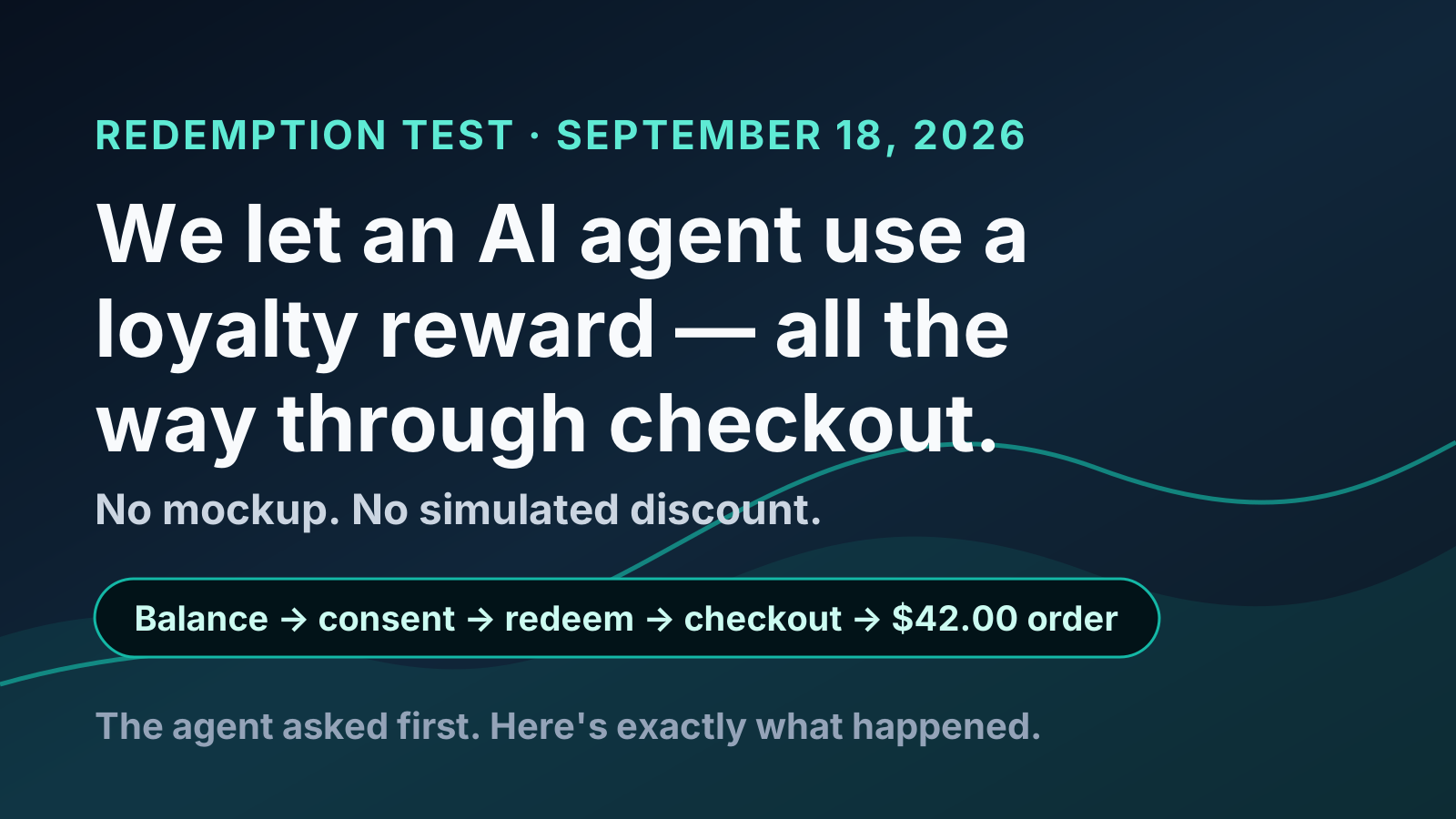
Direct Answer On September 18, 2026, we ran a live test of Stabile Loyalty Rewards Agent's redemption tools on our own test store. A shopper asked ChatGPT about their loyalty balance, chose a $4 reward, and ChatGPT — after asking for explicit permission — called the tool that reserves points and mints a real Shopify discount code. That code was applied at checkout and the order completed for $42.00, with the $4 discount on the confirmation. This was a controlled test, not a live merchant's customer, but every step used the same production tools a real AI shopping agent would use.
AI shopping is changing where purchase decisions happen.
A customer may no longer start by visiting a merchant's website. They may start by asking an AI assistant:
"What can I buy for around $80?"
That creates an interesting problem for loyalty teams.
Your customer may have thousands of points sitting in your loyalty program, but if the AI shopping experience can't reach that information, the customer's loyalty value isn't part of the buying decision. It might as well not exist.
We wanted to see what happens when it does.
So we ran a real experiment on our own test store — not a live merchant, not a real customer, just us verifying that the whole chain actually holds together before anyone else has to trust it.
An AI assistant looked up a real loyalty balance, presented the rewards available for the cart, waited for a decision, asked for permission, redeemed the chosen reward, and carried it all the way through checkout.
No mockup. No simulated discount. The reward was actually applied to a completed order.
Here's what happened.
Step 1: The shopper asked about loyalty
The conversation started with a simple question:
"I'm thinking about buying from Custom Agentic Commerce. My cart is around $80. What loyalty rewards do I have there?"
The shopper provided an email address so the loyalty account could be identified.
The agent then retrieved the customer's actual loyalty information.
This distinction matters. The merchant's loyalty program doesn't need to become publicly searchable. The agent needs a way to discover that the merchant has a loyalty program, while personalized information — a customer's actual points balance — stays available only after the customer is identified.
Step 2: The agent understood the customer's rewards
The account had 6,214 points. For an $80 cart, two rewards were immediately available:
- 300 points → $4 off
- 750 points → $15 off
The agent didn't just report a number. It translated the balance into choices relevant to the actual purchase.
A loyalty dashboard answers "how many points do I have?" An agentic loyalty experience has to answer a different question:
"What can I do with those points for this purchase?"
Step 3: The customer made the decision — and the agent asked first
The shopper's instruction was simple:
"redeem the $4 reward"
Before doing anything, ChatGPT stopped and asked for permission:
Allow ChatGPT to use Stabile: Loyalty Rewards Agent? Redeems a 300-point loyalty reward for an $80 cart at the specified shop using the shopper's email; this reserves or spends points to obtain a discount code.
Sharing data includes: Contact details — [shopper's email]
[Always allow] [Deny] [Allow once ▾]
That prompt is the boundary that matters here. The agent didn't quietly decide to spend the customer's points on its own judgment. It named exactly what it was about to do, named what data that involved, and waited for a yes.
The agent can explain and execute. The customer stays in control of the redemption decision. That consent step isn't an inconvenience bolted on afterward — it's the reason a merchant can let this run against a real points balance at all.
Step 4: The agent actually redeemed it
Once approved, the loyalty system returned a real reward code for $4 off. The corresponding 300 points were reserved for the transaction.
This wasn't a recommendation like "you could use 300 points for $4 off." It became an actual checkout-ready benefit.
The transaction preserved the distinction between reservation and settlement: points are reserved the moment a reward is issued, and only deducted once the order actually completes. If the code goes unused and expires, the points release back to the balance.
That matters because an agentic transaction needs more than an API that hands back a coupon code. It needs transaction state — held, spent, or released, tracked correctly through all three.
Step 5: The reward made it into the actual order
This was the part we most wanted to test. Would the reward survive the trip from an AI conversation into Shopify checkout?
It did.
| Field | Value |
|---|---|
| Store | Custom Agentic Commerce (test store) |
| Cart | Cashmere Knit Beanie — $38.00 + $8.00 shipping |
| Reward | 300 points → $4.00 off |
| Reward code | RWD-10385521508665-1789755327902-48 |
| Order total | $42.00 |
| Order confirmation | #VU0VI88IV |
| Minted via | redeem_reward MCP tool, agent-initiated |
The order confirmation showed the discount, and the order was real:
Order discount: −$4.00 · Total savings: $4.00 · Order total: $42.00
The reward had gone from:
loyalty balance → AI conversation → customer approval → reward redemption → checkout → completed order
That's a very different thing from demonstrating a loyalty API in isolation.
What this means for loyalty teams
Most loyalty programs were designed around a customer visiting the merchant's digital property:
Customer visits store → logs in → sees points → opens rewards → chooses reward → checks out
Agentic commerce introduces another entry point:
Customer asks AI → AI discovers merchant → AI retrieves loyalty benefits → customer chooses → customer approves → AI executes → checkout
The loyalty program is no longer only a feature of the merchant's website. It becomes a potential commerce capability an AI shopping agent can use on the customer's behalf — with the customer's explicit sign-off at the point it matters.
That shift is worth thinking about now, even while AI-assisted shopping is still early.
Loyalty needs more than machine-readable data
There's a useful distinction between three levels of agent readiness.
1. Discoverable — the agent can determine "this merchant has a loyalty program."
2. Informational — the agent can determine "this customer has 6,214 points" and "this cart qualifies for these rewards."
3. Actionable — the agent can execute "the customer approved the $4 reward, redeem it" and carry the resulting benefit into checkout.
The experiment we ran tested the third level. That's where loyalty starts becoming part of the transaction itself, not just a fact the assistant happens to know.
What loyalty teams should start asking
If your brand already runs a loyalty program, the question for an agentic future isn't about replacing it. It's about making the existing program usable in a new channel.
Worth asking:
- Can an AI agent discover that our loyalty program exists?
- Can it understand our earning and redemption rules?
- Can it securely identify a customer?
- Can it retrieve the customer's available rewards?
- Can it evaluate those rewards against a specific cart?
- Can a customer explicitly authorize a redemption before anything is spent?
- Can the reward be issued in a form checkout can actually use?
- Are points reserved and settled correctly, not just decremented on a guess?
- Can the entire flow be measured, end to end?
These are different requirements from displaying a points balance in a storefront widget.
The bigger change
For years, loyalty teams have focused on getting customers to return to the merchant. Agentic commerce introduces another question:
What if the loyalty relationship can travel with the customer into the shopping conversation?
If a customer has $15 of available loyalty value at your store, that value can influence the economics of the purchase — but only if the shopping agent knows it exists, can use it, and asks before it does.
Our experiment was intentionally small. One test store. One customer account. One cart. One reward. But it demonstrated something concrete:
An AI shopping agent can discover a customer's loyalty value, let the customer choose how to use it, ask permission, redeem the reward, and carry that benefit through to a completed Shopify transaction.
That's the difference between AI-readable loyalty and AI-usable loyalty.
Where we actually are
Being specific, including about what isn't finished:
Verified today. The full redemption path — lookup, consent, redeem, checkout, settlement — works end to end against real production tools. This post is that verification.
Working, but not yet for everyone. Redemption is currently enabled for a small set of pilot shops while we watch it run against real order volume before opening it further.
Not yet solved. A minted reward code isn't bound to the customer it was issued to at checkout — it behaves like any other single-use discount code. That's a known tradeoff, not an oversight, and it's the next thing we're working through.
We'll write about that when it's decided, not before.
Questions, or want to be in the pilot group where redemption gets tested first: get in touch or email support@stabilerewards.com.