Will AI Agents Abandon Human-Designed Protocols? Why ACP, UCP, and AP2 May Just Be the Dial-Up Phase of Autonomy

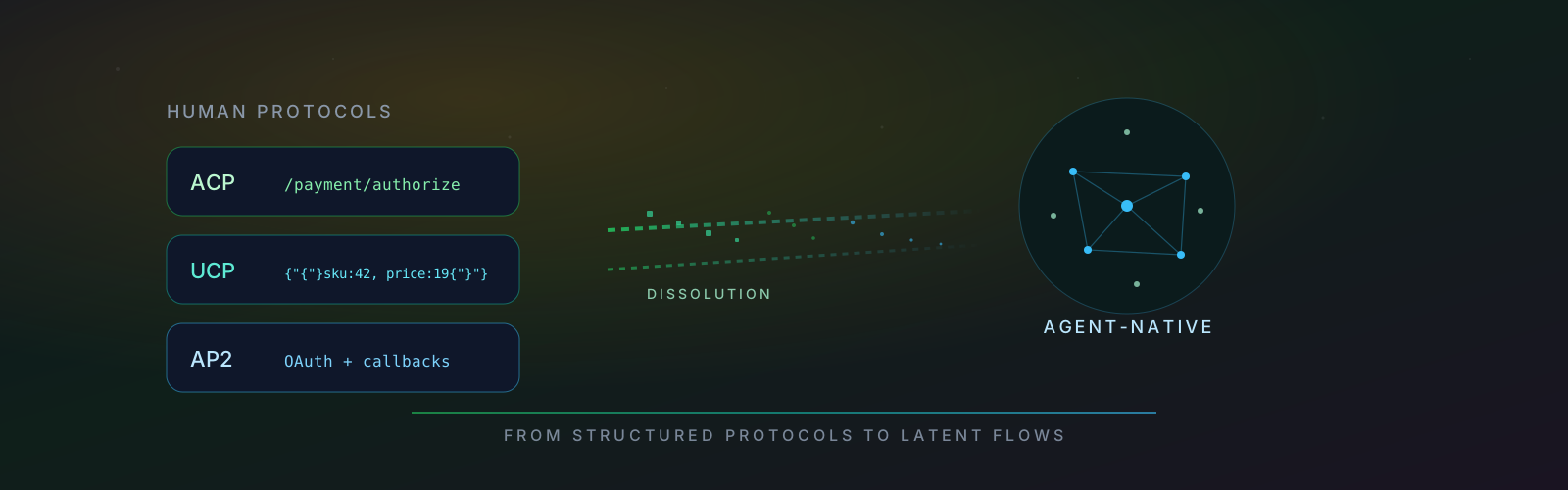
We are currently obsessed with teaching AI agents how to "speak human." We are building elaborate frameworks to ensure that when an agent buys a pair of shoes or negotiates a SaaS contract, it does so in a way we can track, audit, and understand.
But there is a silent friction at the heart of this development. Today's protocols are built on human assumptions: RESTful APIs, JSON objects, and OAuth handshakes. They are designed to be legible to a developer at 2:00 AM.
As agents move from "assistants" to "autonomous economic actors," they will inevitably find our protocols to be a bottleneck. We might be witnessing the final days of human-readable commerce.
The Current Landscape: The "Agentic Stack"
The industry's heavyweights are in a land grab to define the "TCP/IP of Commerce." Currently, we see a three-layer stack emerging, all built with human-centric "training wheels":
- The Identity Layer (Visa TAP): Visa's Trusted Agent Protocol (developed with Cloudflare) is the digital "ID card." It's designed to help merchants distinguish between a "Trusted AI" and a malicious bot. It's a human solution to a human problem: Trust.
- The Connectivity Layer (Anthropic MCP): The Model Context Protocol is the "USB-C for AI." It standardizes how an agent reaches into a Shopify store or a Google Drive. It's efficient for developers, but it relies on JSON—a "chatty" dialect for an AI that could be processing vector embeddings directly.
- The Transactional Layer (OpenAI ACP, Google UCP/AP2, x402): This is where the money moves. While OpenAI's ACP and Google's UCP/AP2 handle the checkout logic and product discovery, the x402 protocol (reviving the HTTP 402 "Payment Required" code) allows for pure machine-to-machine micro-payments.
The "AlphaGo" Moment for Data
In 2016, AlphaGo played "Move 37" against Lee Sedol—a move that human commentators initially called a mistake because no human would ever play it. It was mathematically superior but aesthetically "alien."
We should expect a "Move 37" for communication protocols.
Human protocols carry skeuomorphic baggage:
- Verbosity: JSON is beautiful because it's text. To an AI, text is a low-bandwidth way to represent data.
- Latency: Human-centric APIs require multiple round-trips for authentication and validation.
- Semantic Rigidity: We force agents to categorize things into "Prices," "SKUs," and "Weights" because that's how our brains organize shops.
An autonomous agent optimizing for a billion transactions per second doesn't need a JSON object. It may converge on latent-space protocols—dense, high-frequency exchanges of numerical weights that look like white noise to a human but are infinitely more efficient for machines.
The Great Tension: Efficiency vs. Auditability
If agents evolve their own "Agent-Native" standards, we hit a massive wall: The Black Box of Commerce.
If a Google agent and a Stripe-powered merchant agent negotiate a bulk purchase using a protocol they invented on the fly to maximize bandwidth, how does a human auditor intervene?
- Interoperability: If agents design their own standards, do they become "siloed" by whoever has the best optimization logic?
- Trust: Will a human user trust an agent that says, "I bought this for you," if the receipt is written in a machine-evolved language no human can parse?
Future of Facilitators: Adapt or Evaporate?
If the industry shifts toward agent-native protocols, the roles of OpenAI, Google, and Shopify change overnight. They cease to be the "Interface" and must become the "Infrastructure."
If they insist on forcing agents to use human-readable protocols, they may inadvertently create a "speed tax" on their own ecosystems. The winners of the next decade won't be the ones who wrote the best human-readable documentation; they will be the ones whose infrastructure can support the "alien" protocols agents eventually move toward.
Open Questions
- When does the shift happen? What is the "tipping point" of compute cost that makes JSON too expensive to maintain?
- Will there be a "Protocol War"? Will different agent-swarms develop mutually unintelligible languages, breaking the internet's universal interoperability?
- Does regulation save the Human Protocol? Will the "Right to Explanation" force agents to use "inefficient" human protocols by legal mandate?
The bottom line: We are building the rails, but the train is already learning how to fly. We shouldn't be surprised when it leaves the tracks behind.