The 3 Questions Every Shopify Merchant Should Ask About AI Shopping


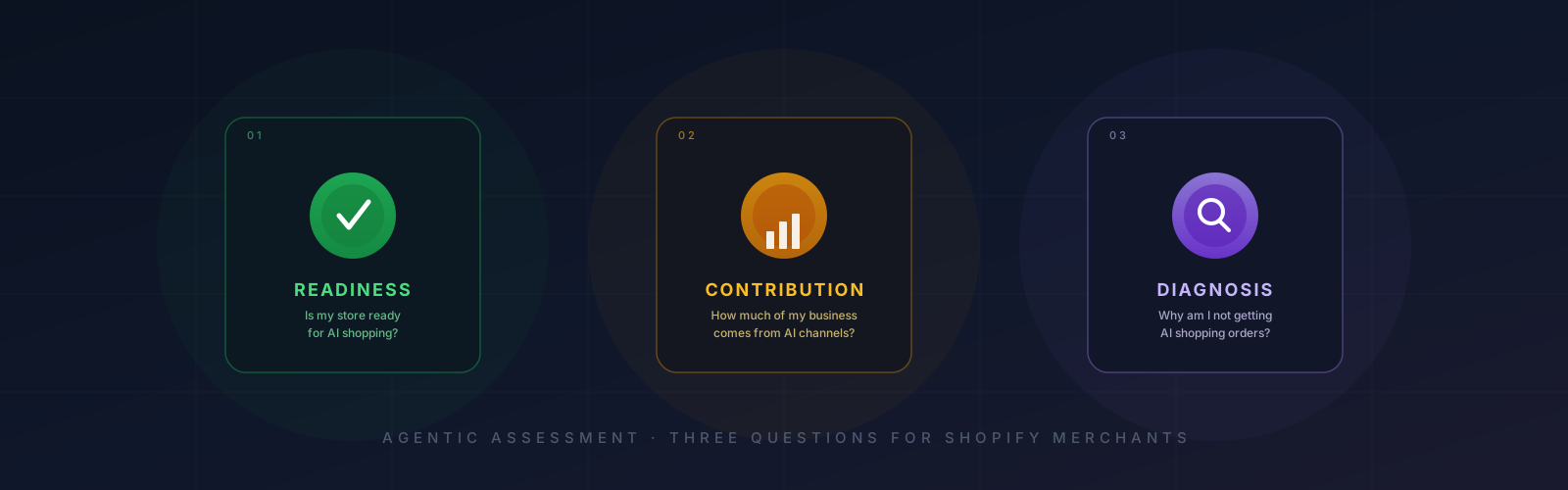
Direct Answer: Stabile's new agentic assessment helps Shopify merchants answer three of the earliest and most important AI-commerce questions: Is my store ready for AI shopping? How much of my business comes from AI channels? and Why am I not getting AI shopping orders? Together, these three checks help merchants understand eligibility, visibility, and measurable channel impact without needing to guess how AI shopping is performing.
As AI shopping moves from novelty to real channel behavior, Shopify merchants are starting to ask a new class of questions.
Not just:
- "Can AI buy from my store?"
But also:
- "Is my store actually ready for AI shopping?"
- "How much AI-driven business am I already getting?"
- "If I am ready, why am I still not seeing orders?"
Those are exactly the questions we built Stabile's agentic assessment to answer.
Instead of giving merchants one vague "AI readiness score," the assessment focuses on three concrete prompts:
- Is my store ready for AI shopping?
- How much of my business comes from AI channels?
- Why am I not getting AI shopping orders?
Each one solves a different layer of uncertainty.
The Core Idea
Merchants do not just need AI-commerce visibility. They need a way to separate readiness, measurable impact, and missing-order diagnosis.
That distinction matters because these are not the same problem.
A store can be:
- technically ready for AI shopping
- seeing little or no AI-attributed revenue
- and still not know whether the issue is setup, visibility, or simple lack of demand
That is why the assessment is built as three separate merchant questions instead of one broad dashboard.
1. "Is my store ready for AI shopping?"
This is the baseline assessment.
It helps answer:
Do we see obvious blockers that could prevent this store from participating in AI shopping at all?
What this check looks at
- storefront access
- catalog participation signals
- required policy coverage
- product quality basics such as title, image, price, and storefront URL
- manual review items such as Shopify Agentic Storefronts status
What this chip is for
This chip is meant to answer the merchant's first and most natural question:
"Before I think about optimization, is anything fundamentally broken?"
That makes it a readiness check, not a growth strategy tool.
What this chip is not for
It does not guarantee:
- AI traffic
- AI-driven orders
- strong product recommendation performance
- broad agent adoption
A merchant can pass this check and still have zero AI shopping orders.
That is not a contradiction. It just means readiness is only the first layer.
2. "How much of my business comes from AI channels?"
This is the measurable impact check.
It helps answer:
Is AI shopping already contributing to completed checkout activity?
What this check looks at
- recent completed checkout activity
- AI-attributed order share
- AI channel contribution as a percentage of completed business
- trend comparison against early-adopter benchmarks when merchant data is still sparse
Why this matters
Many merchants do not need another abstract statement that AI shopping is "important."
They want to know:
- Is this real yet?
- Is it showing up in my store?
- Is it measurable?
That is what this chip answers.
Why this chip is different from readiness
A store may be fully ready for AI shopping and still show:
- 0 AI-attributed completed checkouts
That does not necessarily mean anything is wrong.
It may simply mean:
- the channel is still early
- buyer demand is limited
- the merchant has not yet been surfaced meaningfully in AI shopping flows
This chip turns that ambiguity into something measurable.
3. "Why am I not getting AI shopping orders?"
This is the diagnostic chip.
It helps answer:
If a store looks healthy, is product publication still a likely explanation for missing AI shopping orders?
What this check currently does
Right now, this diagnostic focuses on publication coverage by channel.
It asks:
- which store publications Shopify exposes for the merchant
- whether sampled active products are published across those publications
- whether Online Store coverage looks healthy, since that is the strongest storefront-discoverability signal in the current implementation
Why this matters
A merchant may say:
"You told me my store is ready. So why am I still not seeing AI shopping orders?"
That is a different question from readiness.
It is no longer asking:
- "Is something obviously broken?"
It is asking:
- "Can you help me rule out one likely cause?"
This chip does exactly that.
If publication coverage is healthy, Stabile can now tell the merchant:
Product publishing is probably not the reason AI shopping orders are missing.
That is valuable, even if it does not yet explain every other possible cause.
Why These Three Chips Work Better Than One Generic "AI Score"
Because they map to three very different merchant jobs-to-be-done:
Job 1: Eliminate setup uncertainty
The merchant wants to know:
"Am I even eligible and structurally ready?"
That is the readiness chip.
Job 2: Measure actual business impact
The merchant wants to know:
"Is AI shopping already affecting revenue?"
That is the contribution chip.
Job 3: Diagnose a missing-outcome problem
The merchant wants to know:
"If I seem ready, why am I still not seeing orders?"
That is the diagnostic chip.
One score would blur those together.
Three merchant-language questions make them usable.
What Merchants Learn From This Assessment
Taken together, the three chips help merchants learn:
- whether their store has obvious AI-shopping blockers
- whether AI channels are already measurable in completed business
- whether publication coverage is likely to explain missing AI shopping orders
That gives merchants something much more practical than hype.
It gives them:
- a baseline
- a measurable signal
- a first diagnostic branch
What This Assessment Does Not Pretend to Solve Yet
This is important.
The current assessment does not fully diagnose every reason a merchant may be missing AI shopping orders.
For example, it does not yet automatically resolve:
- demand limitations
- AI-channel availability differences
- ranking or recommendation visibility inside AI shopping experiences
- broader catalog competitiveness beyond the current checks
That is intentional.
The point of this release is not to pretend the app knows everything.
The point is to answer the earliest merchant questions honestly and usefully.
Why We Built It This Way
AI shopping introduces a new kind of merchant confusion.
A merchant can now be:
- enabled for AI shopping
- visible in some surfaces
- not visible in others
- measurable in checkout data
- or not measurable yet
And most merchant tools still collapse all of that into vague language.
We wanted a more useful model:
readiness contribution diagnosis
That is the logic behind the three-chip assessment.
Final Takeaway
The first wave of AI-commerce tools told merchants that AI shopping was coming. The next wave needs to help merchants understand what is actually happening in their own store.
That is what this assessment is designed to do.
If you are a Shopify merchant, these are the three practical questions worth asking first:
- Is my store ready for AI shopping?
- How much of my business comes from AI channels?
- Why am I not getting AI shopping orders?
Those questions do not solve all of AI commerce.
But they do give merchants something much better than hype:
a clear starting point.

Frequently Asked Questions
What is the difference between "Is my store ready for AI shopping?" and "How much of my business comes from AI channels?" The first is a blocker check. It looks for structural issues that could prevent participation in AI shopping. The second is a measurement check. It looks for completed checkout activity already attributed to AI channels.
Why does Stabile separate "Why am I not getting AI shopping orders?" from readiness? Because a merchant can be technically ready and still see no AI-driven orders. The diagnostic chip exists to investigate likely reasons for that gap instead of treating readiness and outcomes as the same thing.
Does passing the readiness check guarantee AI shopping orders? No. It means Stabile did not find major early blockers in the current assessment. Traffic, demand, channel rollout, recommendation visibility, and other factors can still affect results.
What does the "Why am I not getting AI shopping orders?" chip currently check? It currently focuses on publication coverage by channel, especially whether sampled active products are published on Online Store and other store publications Shopify exposes.
Why is this useful if it does not diagnose every cause yet? Because ruling out one plausible cause is still valuable. Merchants do not need a fake all-knowing answer. They need a clear next layer of understanding.